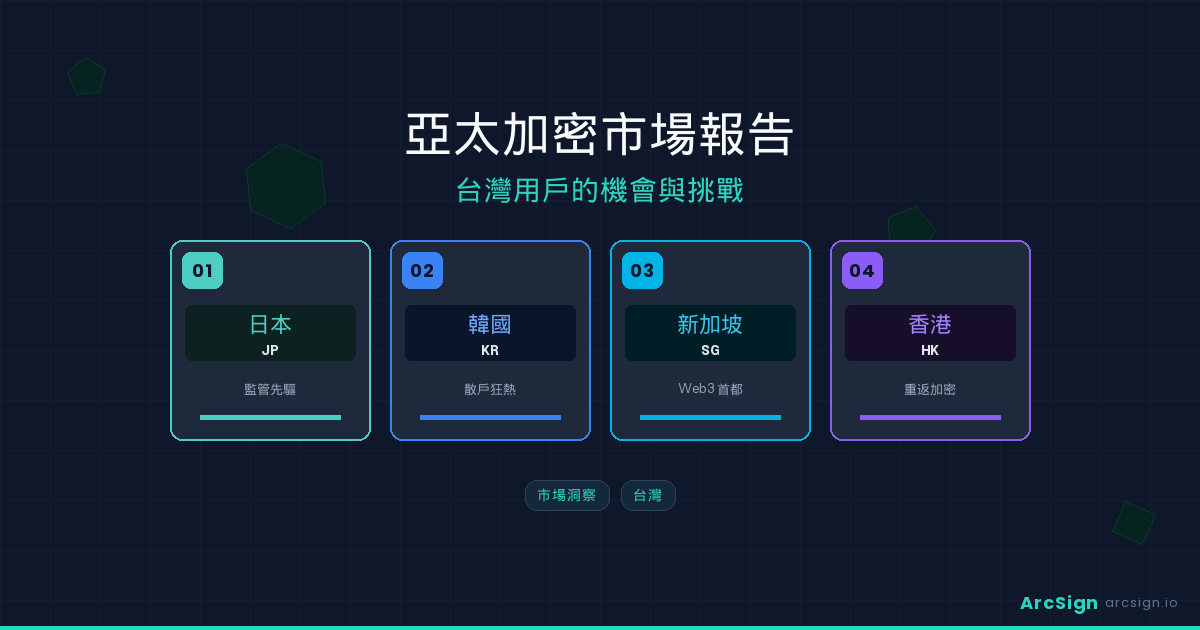
2026 Asia-Pacific Crypto Market Overview
The Asia-Pacific region has become the core driver of the global cryptocurrency market in 2026. According to multiple industry research reports, the APAC region accounts for over 40% of global crypto trading volume, with more than 260 million active wallet addresses and a year-over-year growth rate of 35%. From Tokyo to Singapore, Seoul to Hong Kong, governments and regulators are actively establishing the rules of the game for crypto assets.
For Taiwanese users, this is a moment filled with both opportunity and challenge. We’re positioned at the heart of the APAC crypto economy, with a highly tech-literate population and mature digital infrastructure, yet we also face the reality of a regulatory framework still under development and a relatively limited domestic market scale. This report provides an in-depth analysis of the major APAC markets and how Taiwanese users can find the best strategy in this regional race.
| Stat | Detail |
|---|---|
| 40%+ | APAC share of global volume |
| 260M | Active wallet addresses in APAC |
| 35% | Year-over-year growth |
Key Observation
The defining theme of the 2026 APAC crypto market is “regulatory clarity driving institutional capital inflow.” Countries are no longer choosing between banning or ignoring crypto — they’re finding the balance between risk management and innovation encouragement.
Five Key Markets Compared: Taiwan, Japan, Korea, Singapore & Hong Kong
The five major crypto markets in Asia-Pacific — Taiwan, Japan, South Korea, Singapore, and Hong Kong — each have their unique positioning and development trajectory. Here’s a comparison across four dimensions: regulatory framework, market size, user behavior, and DeFi ecosystem:
| Criteria | Taiwan | Japan | Korea | Singapore | Hong Kong |
|---|---|---|---|---|---|
| Regulatory Maturity | Developing | Mature | Mature | Mature | Mature |
| Retail Participation | High | Medium | Very High | Medium | Medium |
| Institutional Participation | Low | High | Medium | Very High | High |
| DeFi Ecosystem | Emerging | Conservative | Active | Active | Developing |
| Self-Custody Friendly | Unrestricted | Unrestricted | Conditional | Unrestricted | Unrestricted |
| Tax Policy | Unclear | Up to 55% | 20% (from 2027) | No capital gains tax | No capital gains tax |
Japan: Strict but Clear Regulatory Pioneer
Japan was one of the first countries globally to bring crypto exchanges under regulatory oversight. The Financial Services Agency (FSA) requires exchanges to be licensed and enforces strict client asset segregation policies. This “strict but clear” approach means Japan’s market is slower to innovate, but institutional investor confidence is the highest in the region. In 2026, Japan has further relaxed stablecoin-storage-guide.html” style=“color:var(—primary);“>stablecoin issuance regulations, positioning itself as one of Asia’s stablecoin hubs.
South Korea: Retail Frenzy Meets Regulatory Catch-Up
South Korea’s crypto market is famous for its extremely high retail participation, with the “Kimchi Premium” phenomenon persisting over the years. After the Virtual Asset User Protection Act officially took effect in 2024, Korea has accelerated its regulatory framework development. Notably, Korea’s planned crypto income tax — originally set for 2025 — has been postponed multiple times and is now expected to take effect in 2027.
Singapore: Asia’s Web3 Capital
The Monetary Authority of Singapore (MAS) has established the most comprehensive crypto asset compliance framework in APAC through its Digital Payment Token (DPT) licensing regime. Combined with zero capital gains tax, Singapore has become the preferred Asian headquarters for Web3 companies worldwide. Numerous DeFi protocols, NFT platforms, and blockchain infrastructure companies have established operations here.
Hong Kong: Back on the Crypto Stage
After launching its Virtual Asset Trading Platform (VATP) licensing regime in 2023, Hong Kong has been actively rebuilding its status as a crypto hub. By 2026, more than 10 licensed exchanges are operating, and Asia’s first spot Bitcoin and Ether ETFs have been launched. Hong Kong’s positioning leans more toward institutional-grade services and high-net-worth clients, complementing Singapore’s broader approach.
Taiwan’s Position: Strengths & Bottlenecks
Taiwan occupies a unique position in the APAC crypto market. We have a world-leading semiconductor industry and a highly digitized society, yet our crypto asset regulatory framework is still being constructed. The Financial Supervisory Commission (FSC) has been gradually bringing VASPs under management since 2023, requiring KYC/AML compliance, but a comprehensive dedicated act has yet to be enacted.
Taiwan’s Three Key Strengths
1. Highly Tech-Literate Population
Taiwan’s smartphone penetration exceeds 90%, internet coverage approaches 95%, and the rollout of the national digital identity (TW FidO) demonstrates high public acceptance of digital financial tools. This means the learning curve for advanced tools like cold wallets, DeFi, and cross-chain operations is relatively low.
2. Self-Custody Friendly Policy Environment
Unlike some countries that have attempted to restrict self-custody wallets, Taiwan currently imposes no restrictions on individuals holding and using cold wallets. You can freely withdraw assets from exchanges to self-custody wallets like ArcSign, which is crucial for asset security and privacy protection.
3. Strategic Geographic Position
Taiwan sits at the intersection of three major APAC crypto markets — Japan, Korea, and Southeast Asia. Our timezone advantage allows Taiwanese users to participate in DeFi activities and token events across all Asian markets without missing any market’s active hours.
Bottlenecks Taiwan Faces
However, Taiwan also faces some structural challenges. First is regulatory uncertainty — the dedicated Virtual Asset Management Act is still in legislative discussion, and the lack of clear regulations keeps institutional investors on the sidelines. Second is market scale — Taiwan’s GDP and population are smaller compared to Japan and Korea, limiting the fundraising capacity of local crypto projects. Third is fiat on/off ramps — Taiwan’s banking system remains cautious about crypto businesses, making fiat conversion less convenient than in Singapore and Hong Kong.
Three Key Opportunities for Taiwanese Users
Opportunity 1: Cross-Regional DeFi Yield Arbitrage
DeFi protocols across APAC markets exhibit differences in yield rates and liquidity. Taiwanese users can leverage ArcSign’s DEX Swap feature to connect to DeFi protocols on different chains via WalletConnect, participating in cross-chain yield opportunities while maintaining cold storage security. For example, stablecoin lending rates on BSC are typically higher than on Ethereum mainnet, and Polygon’s liquidity mining programs often offer additional incentives.
Opportunity 2: First-Mover Advantage in RWA Tokenization
Real World Asset (RWA) tokenization is the hottest institutional focus area in 2026. Singapore has already begun piloting tokenized real estate and bond trading, while Japan has launched its Digital Securities (Security Token) framework. Taiwanese users can position themselves early in these emerging asset classes through multi-chain cold wallets. ArcSign supports 7 chains, covering the major platforms where RWA tokens are being issued.
Opportunity 3: Becoming an APAC Web3 Talent Exporter
Taiwan’s software engineering talent ranks among the best in APAC. As Web3 companies in Singapore and Hong Kong expand rapidly, demand for blockchain developers continues to surge. Taiwan’s developer communities (such as Ethereum groups and blockchain education organizations) have already formed a healthy ecosystem — this represents both a personal career opportunity and increased Taiwanese influence in the APAC crypto sphere.
Practical Tip
To participate in cross-chain DeFi opportunities across APAC, use a multi-chain self-custody cold wallet. ArcSign supports 7 EVM chains, and with WalletConnect, you can flexibly interact with DeFi protocols on any chain while keeping your assets in secure cold storage.
Four Challenges You Must Address
Challenge 1: Uncertain Regulatory Compliance Costs
Taiwan’s crypto regulation continues to evolve. For individual users, the most direct impact is tax reporting obligations. While Taiwan’s tax treatment of crypto transactions is not yet fully defined, given global trends, the introduction of clear taxation rules within the next few years is virtually certain. We recommend users start maintaining complete transaction records now to prepare for future reporting requirements.
Challenge 2: Exchange Centralization Risk
Taiwanese users are heavily dependent on a small number of exchanges. History has repeatedly shown that even major exchanges can collapse suddenly due to hacking attacks, internal mismanagement, or regulatory issues. The 2022 FTX collapse remains the most painful lesson. Self-custody is the best risk mitigation strategy — store the majority of your assets in a cold wallet and keep only the amounts needed for active trading on exchanges.
Challenge 3: Cross-Border Compliance Complexity
When Taiwanese users interact with overseas DeFi protocols or open accounts on Hong Kong or Singapore exchanges, they need to comply with regulations across multiple jurisdictions simultaneously. In particular, the FATF (Financial Action Task Force) “Travel Rule” is being progressively implemented across APAC countries, which will increase the compliance costs of cross-border crypto transactions.
Challenge 4: Information Asymmetry & Scam Risks
Crypto scam incidents across APAC continue to rise, and Taiwan is no exception. From phishing attacks to fake investment platforms, many scam tactics exploit information asymmetry around emerging markets and cross-border investments. Staying vigilant, using secure self-custody tools, and verifying every transaction’s target address are fundamental protective measures.
The Role of Self-Custody Wallets in the APAC Market
As APAC regulatory frameworks take shape, a clear trend is emerging: the importance of self-custody is being re-recognized. Whether it’s the 2022 FTX incident or the 2023 Ledger Recover controversy, users have realized that “controlling your own keys” isn’t just a slogan — it’s a practical asset protection strategy.
In the APAC region, demand for self-custody wallets is growing rapidly. Reasons include: increased risk of asset freezing as exchange regulations tighten, cross-border usage needs (one wallet works in any country), and the requirement for non-custodial wallets to interact with DeFi protocols.
| Consideration | Exchange Custody | Self-Custody Cold Wallet |
|---|---|---|
| Asset Control | Exchange holds private keys | Full self-sovereignty |
| Cross-Border Use | Subject to national regulations | Globally unrestricted |
| DeFi Compatibility | Must withdraw to external wallet | Direct DApp connection |
| Exchange Collapse Risk | Assets may be completely lost | Unaffected |
| Privacy | All operations logged | On-chain records only |
ArcSign, as a free USB cold wallet, is particularly well-suited for APAC user scenarios. It supports 7 EVM chains, covering the most commonly used networks in the APAC region. Through WalletConnect v2, users can connect to DeFi protocols on any chain while maintaining cold storage security. Combined with XOR three-shard encryption and AES-256 encrypted .arcsign backup files, your private keys receive multi-layered protection.
Action Plan for Taiwanese Users
Based on our analysis above, here’s a concrete action plan for Taiwanese users:
1. Establish a Self-Custody Security Foundation
Transfer the majority of your assets (recommended 80%+) to a cold wallet. ArcSign is a free option that provides USB backup strategies and encrypted backup files, ensuring you can recover your assets under any circumstances.
2. Build Transaction Record Habits
Start recording every transaction’s date, amount, token, and counterparty from today. This prepares you for future tax reporting and serves as a foundation for investment decision analysis. ArcSign’s transaction history feature can help you track cross-chain operations.
3. Diversify Across APAC Market Opportunities
Don’t focus on a single market or single chain. Use ArcSign’s multi-chain management features to establish positions across Ethereum, BSC, Polygon, Arbitrum, and other chains to participate in DeFi opportunities across different markets.
4. Stay Informed on Regulatory Developments
Follow FSC announcements and track crypto policy changes across APAC countries. Regulatory changes may create new opportunities (such as new compliant token offerings) or bring challenges that need to be addressed (such as new reporting obligations).
5. Enhance Security Awareness
Read our phishing attack prevention guide and seed phrase backup guide to build a comprehensive security defense. In the increasingly active APAC market, security is the prerequisite for all operations.
Frequently Asked Questions
Q: What is the current state of crypto regulation in Taiwan?
Taiwan’s Financial Supervisory Commission (FSC) has brought Virtual Asset Service Providers (VASPs) under its management framework, requiring exchanges to implement KYC and AML procedures. In 2026, the government continues advancing its dedicated Virtual Asset Management Act, balancing investor protection with industry development. Personal holding and use of self-custody wallets like ArcSign remains unrestricted.
Q: Which Asia-Pacific market is the most crypto-friendly?
Singapore and Hong Kong are the most crypto-friendly markets in the Asia-Pacific region. Singapore’s MAS issues Digital Payment Token (DPT) licenses providing a clear compliance framework. Hong Kong has launched its Virtual Asset Trading Platform (VATP) licensing regime, allowing retail investors to trade major cryptocurrencies. Both are actively attracting Web3 companies to establish operations.
Q: How can Taiwanese users safely manage their crypto assets?
Taiwanese users should use self-custody cold wallets like ArcSign to secure the majority of their assets, keeping only small trading amounts on exchanges. ArcSign provides XOR three-shard encryption, AES-256 encrypted backup files, and mlock memory protection — all for free, with support for 7 chains, making it ideal for APAC users who need to manage assets across multiple chains.
Q: What are the key trends in the Asia-Pacific crypto market for 2026?
Key 2026 APAC crypto trends include: accelerated regulatory framework implementation (especially Japan, Korea, and Taiwan), significant increase in institutional investor participation, rapid DeFi and RWA (Real World Asset tokenization) growth in Southeast Asia, rising demand for self-custody solutions, and the proliferation of Layer 2 and cross-chain infrastructure across the region.