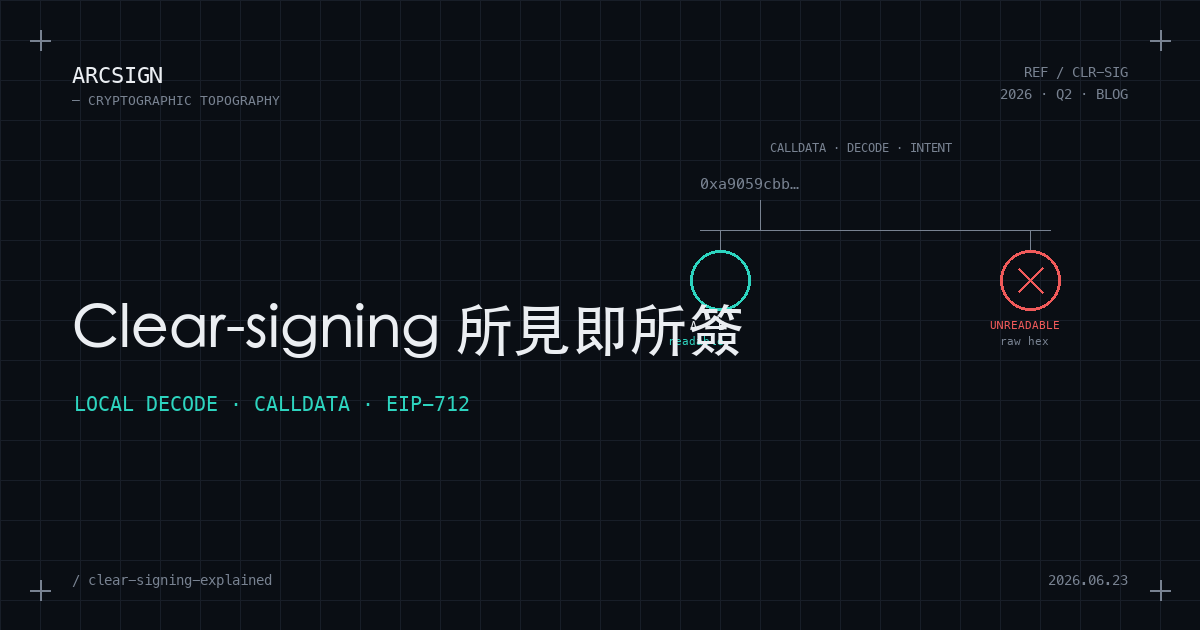
The core promise of a cold wallet is “secure signing.” But if, the moment you press sign, the screen only shows a truncated string of hex—0xa9059cbb000000...—then that promise is hollow. You have no idea what you’re authorizing. This is called blind signing, and for a cold wallet that markets itself on security, it’s a flaw in the very positioning.
ArcSign v1.5.0’s clear-signing feature exists to fix exactly this: it decodes raw hex into human-readable intent, right on your own machine. This post breaks down how it works, along with several deliberate design trade-offs.
Clear-signing in one sentence
WalletConnect and mint signing screens no longer show truncated hex. Instead, ArcSign decodes locally what the transaction is actually doing—a transfer, an approval, an unlimited approve, a setApprovalForAll, or a decoded DEX swap. When it can’t decode something, it honestly says “unable to read” and shows the raw hex.
The Problem: What a Transaction Actually Looks Like
When a dApp asks you to sign a transaction over WalletConnect, the heart of what it sends is a data field—a string of hex. The first 4 bytes of that hex are the function selector, and the rest is the ABI-encoded arguments.
For example, the data of an ERC-20 transfer looks like this:
0xa9059cbb                                          ← selector for transfer(address,uint256)
  000000000000000000000000<recipient address 20 bytes>      ← argument 1: recipient
  0000000000000000000000000000000000000000000de0b6b3a7640000  ← argument 2: amount
To a human, this is gibberish. But once you know that 0xa9059cbb maps to transfer(address,uint256), you can decode it back into “send 1 token to some address.” That’s exactly what decoding does.
Local Decoding, Zero External APIs
ArcSign uses viem—a well-maintained TypeScript Ethereum library—to decode locally in the frontend. This is a deliberate privacy decision:
The decoding process makes no network requests at all. No calls to 4byte.directory, no Etherscan label API, no sending the contents of your transaction to any third party to “interpret for you.” Doing that would amount to leaking “what you’re about to sign” to an external service. Decoding happens on your machine, using a built-in list of ABIs.
We even wrote a test for this—verifying that the decoding flow genuinely performs zero fetches, pinning “privacy” down as an invariant guarded by CI rather than leaving it as a slogan.
What Decoding Covers
ArcSign ships with a set of ABIs for known functions (KNOWN_ABIS), covering the operations you’ll encounter most in daily use—and the ones you most need to see clearly:
transfer/transferFrom— token transfers, decoded into amount and recipientapprove— approvals. If it’s an unlimited approval (the amount is the maximumuint256value), it’s flagged in red—this is one of the operations most often abused in phishingsetApprovalForAll— handing control of an entire batch of NFTs to some operator; flagged in red when set totrue- Permit2 / Permit — EIP-712 authorization signatures, labeled as “authorization signature”
- native transfers — sending ETH/BNB and the like directly
Token names are resolved using the local token list (also with zero external APIs).
Special Handling for DEX Swaps
Swaps are one of the most common operations over WalletConnect, but also the hardest to decode—every DEX’s router function signature is different. v1.5.0 adds structured decoding for the major DEXes:
- Uniswap / PancakeSwap V2 (
swapExactTokensForTokensand similar) - V3 (
exactInputSingle/exactInput, including packed path parsing) - 1inch / KyberSwap (the aggregator’s swap description struct)
- OpenOcean and generic aggregators (
swapExactIn)
The decoded result is shown as “A → B, minimum received X”—so you can tell at a glance what you’re swapping and what the slippage floor is.
Swap decoding follows a “fixed cases first, generic detection as fallback” strategy: it first matches against known router signatures, and only falls back to a structured generic detector (detectSwap) when nothing matches. That detector is extremely conservative—if there’s any uncertainty it returns null, preferring to display “unable to read” over guessing at a swap that might be wrong.
Drawing out the decoding decision flow makes it clearer how “honesty” is built into the branches:
calldata sent by the dApp (hex)
        │
        ▼
  take first 4 bytes = function selector
        │
        ▼
  found in local KNOWN_ABIS?
        │
   ┌────┴─────┐
  yes           no
   │             │
   ▼             ▼
 viem local decode   is it a swap sig? (detectSwap, very conservative)
   │             │
   │        ┌────┴────┐
   │       yes          no
   │        │            │
   │        ▼            ▼
   │     decode A→B   online toggle on? → fetch ABI from Sourcify
   │     min received X   │
   │        │       ┌────┴────┐
   │        │     found      not found / can't decode
   ▼        ▼       │            │
 ┌──────────────────┘            ▼
 │  readable summary       ⚠️ unable to read this tx
 │ (red flag: unlimited approve /   + expandable raw hex
 │   setApprovalForAll)       (no false sense of safety)
 └──────────────────────────────┘
When in doubt, it heads toward “unable to read” rather than guessing—this conservative branch design is the concrete implementation of the honesty principle.
The Honesty Principle: If It Can’t Decode, It Says So
This is the most important design philosophy in the entire feature.
If a transaction can’t be decoded—an unknown selector, malformed data, a contract it has never seen—ArcSign does not invent an interpretation. It clearly shows “⚠️ unable to read this transaction” and provides an expandable section so you can inspect the raw hex.
Why does this matter? Because for a security tool, a confident but wrong interpretation is more dangerous than honestly admitting “I can’t read this.” If we displayed a harmless-looking fake summary for a malicious transaction, that would be worse than showing a string of hex—the user would sign with confidence, based on wrong information. So ArcSign’s decoder would rather fall back conservatively to “unable to read” than risk offering a possibly misleading interpretation.
Online ABI Fallback (Optional)
A local list of ABIs can never cover every contract. So v1.5.0 adds an optional online fallback: when the local list can’t decode a contract, it can fetch a verified ABI from Sourcify (a decentralized contract verification service) to decode it.
This feature:
- Can be enabled by default, but with a one-time privacy notice—because it sends the contract address to Sourcify, and users deserve to know
- Has an encrypted USB cache—ABIs that have been fetched are stored locally, so there’s no need to fetch them again next time
- Still honors the honesty principle—even if an ABI is fetched but the semantics still can’t be resolved, it displays “unable to read” all the same
Fetching an ABI ≠ understanding the intent. Sourcify gives you a contract’s function interface, but if what that function does isn’t covered by our presentation logic, the honest thing is still to fall back to unreadable.
Decode in the Frontend, but the Security Gate Is in the Backend
There’s one point that’s easy to confuse and worth clarifying: clear-signing’s decoding is done in the frontend (viem decoding locally), but this does not violate ArcSign’s principle that “security decisions live in the backend.”
The distinction is this: decoding is auxiliary presentation of information—it helps you understand a transaction, but it is not a security gate. The real security enforcement (blacklist hits, danger determination, refusing to sign) happens in the Go backend, before the private key is ever used (see the signing security gate post for that part). Clear-signing lets you understand; the security gate decides whether to block—two separate things, handled in separate layers.
Why This Feature Matters
“What You See Is What You Sign” is one of the core concepts of hardware wallet security. A cold wallet that lets you blind-sign throws away its most important line of defense—because the very essence of a phishing attack is getting you to sign a transaction that works against you without your knowing it (an unlimited approve, a setApprovalForAll).
v1.5.0’s clear-signing restores that line of defense: at the most critical moment—the moment of signing—you can understand what you’re authorizing.
To see the other upgrades in this release, head back to the v1.5.0 release overview.