Does Your Crypto Have a “Will”?
In traditional finance, when someone passes away, banks, brokerages, and insurance companies all have well-defined legal processes for transferring assets to heirs. In crypto, things are completely different — there is no customer service line, no central authority, no court that can force a transfer. If the private keys you control are not communicated to your family in some form, your entire portfolio is permanently locked on-chain. No one will ever spend it again.
According to a 2024 estimate from the Cambridge Centre for Alternative Finance (CCAF), roughly 20% of all bitcoin (about 3.8 million BTC) has been permanently lost, and a sizable share of that is attributable to holders who died without leaving inheritance instructions. With BTC trading well above $100,000, that adds up to $380+ billion in crypto wealth that families around the world cannot reclaim.
The Core Tension
Crypto inheritance has a built-in contradiction: security and inheritability seem to fight each other. The tighter you lock your keys away, the harder it is for your family to access them; the more accessible you make them, the easier it is for attackers to win. This guide is about achieving both at once.
Why Is Crypto Inheritance Harder Than Traditional Inheritance?
One of crypto’s defining traits is being “trustless” — there is no custodian holding your assets. That is a huge advantage while you are alive and able to control your keys, but the moment you are incapacitated or gone, it becomes a fatal weakness. Here is why crypto inheritance is structurally harder than the traditional kind.
1. There Is No “Freeze” or “Unfreeze” Button
When a bank account holder dies, family members can use a death certificate and probate to freeze and eventually take over the account. On-chain, no party has the power to freeze your wallet, and equally, no party can authorize your family to “thaw” it and take control. Whoever holds the private key is, in practice, the owner.
2. The Gap Between Law and Technology
Most jurisdictions now recognize crypto as inheritable digital property — see Taiwan’s Civil Code §1148, Germany’s BGB §1922, the U.S. RUFADAA model law, and similar provisions in the U.K., Japan, and Singapore. But law only answers who has the right to inherit, not how to technically obtain access. If your heir has a legal claim but cannot get hold of your keys, the law cannot reach into the blockchain to help.
3. The “All or Nothing” Risk of Seed Phrases
Most wallets back up with a 12- to 24-word BIP39 seed phrase. Writing it on paper and locking it in a safe is reasonable, but it concentrates the entire key in one place — fire, flood, theft, or a family member finding it accidentally can all become catastrophic. Worse, a single glance is enough to compromise a plaintext seed, and there is no second line of defense.
Real-World Case
In 2018, the founder of Canadian crypto exchange QuadrigaCX, Gerald Cotten, died unexpectedly while traveling in India. $190 million in customer assets vanished with the private keys he kept on his personal laptop, and most of it has never been recovered. While that was an exchange tragedy rather than an individual inheritance, it vividly illustrates the consequences of a single key disappearing.
4. The Knowledge Barrier Creates a Second Wave of Risk
Even if you leave your seed phrase or backup file intact, your family may not know how to operate it. A grieving relative frantically searching for “how to import seed phrase” can easily fall victim to phishing websites or fake wallet apps. An inheritance plan must transmit not just the keys, but also the knowledge of how to use them safely.
Mainstream Inheritance Approaches: Pros and Cons
Before walking through ArcSign’s approach, let us honestly examine the major existing methods so you can see what each one trades off.
Approach A: Paper Seed Phrase + Lawyer Custody
Write the 12- or 24-word seed phrase on paper, seal it in an envelope, and deposit it with your lawyer along with a will instruction. This is the most common and intuitive method.
Pros: Clear legal process, lawyer has confidentiality duty, heir does not need to understand technical detail.
Cons: Law firm breaches, dishonest employees, fire, flood — all real risks. The critical issue is that a single point of failure compromises everything.
Approach B: Shamir’s Secret Sharing (SLIP-39)
Hardware wallets like Trezor support Shamir Backup, splitting a seed into multiple shares (say, 5) where any 3 can reconstruct it. You distribute shares to different family members or lawyers, and when needed they assemble three of them.
Pros: Risk is distributed, no single custodian can compromise everything, harder for any small group to collude.
Cons: Requires buying a SLIP-39-capable hardware wallet, heirs must know how to operate that specific hardware, and coordination becomes difficult if shareholders lose contact.
Approach C: Multi-Signature Wallets
A 2-of-3 or 3-of-5 multisig (e.g., Gnosis Safe) lets you give partial signing power to family members or counsel; when the threshold is met, the assets can move.
Pros: Active even before death, defends against any single key compromise.
Cons: Higher gas costs, EVM-only, complex setup, smart contract bug risk (in 2024, WazirX’s multisig was drained for $230 million).
Approach D: Exchange “Dead Man’s Switch”
Some custodial exchanges (e.g., Coinbase) let you nominate beneficiaries who can claim the account after a period of inactivity.
Pros: Fully automated, requires no family action.
Cons: Funds must sit on a centralized exchange — exposing you to FTX-style failures (see exchange hack history) — and the entire approach is at odds with the self-custody ethos.
ArcSign’s Approach: Encrypted .arcsign Backup + Split Instructions
ArcSign is naturally suited to inheritance. The core idea is simple: let your family unlock the wallet only when all three pieces — the encrypted backup file, the unlock password, and a usable operating manual — are brought together. Possession of any single piece on its own is harmless.
Why the .arcsign Backup File Is Inheritance-Friendly
The .arcsign backup file is a single file encrypted with AES-256-GCM. It is encrypted at the moment of export — there is no separate “set a password” step afterwards. That gives it several inheritance-friendly properties:
Inheritance-Friendly Properties
- Single, portable file. Your whole wallet collapses into one file that fits on a USB stick, in cloud storage, in a safe deposit box, or even on a printed QR code.
- Harmless when exposed. Even if the file leaks, no password means no access. It can live in places lawyers can reach.
- Self-verifying. AES-256-GCM has built-in tampering detection — a corrupted or substituted file simply fails to decrypt, so your heirs will not be misled by a fake.
- No proprietary hardware required. Heirs only need to download the free ArcSign software; no particular brand of hardware wallet is needed.
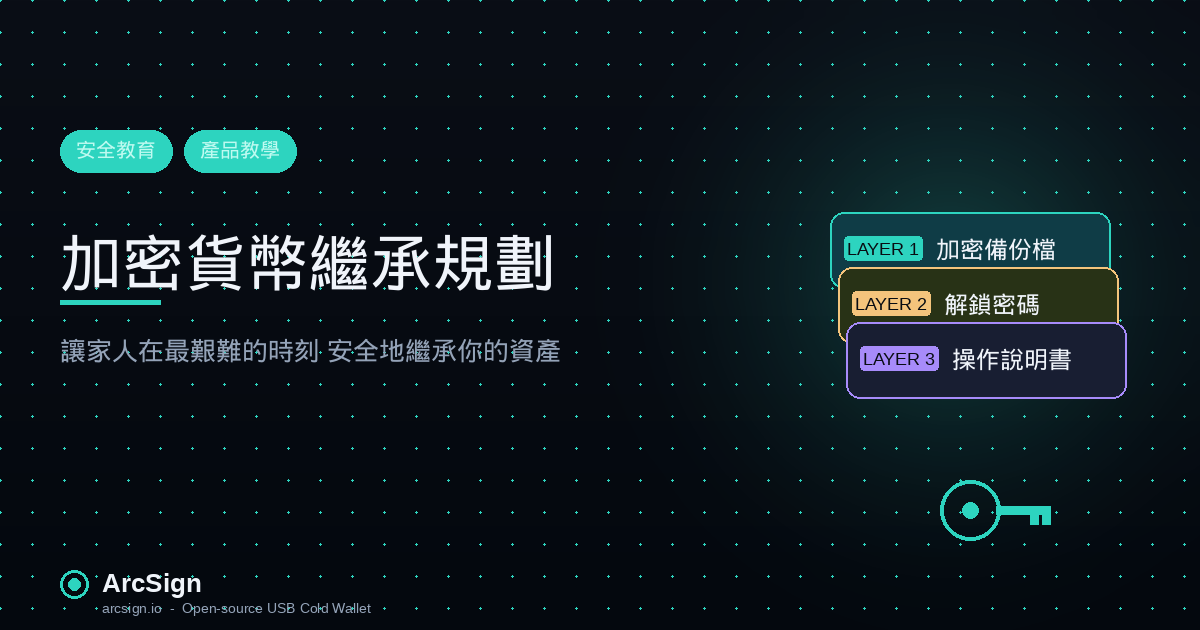
The Three-Layer Separation Architecture
The architecture we recommend places each ingredient with a different custodian in a different location:
Layer 1 — Encrypted Backup File (.arcsign)
Can live on: a personal USB, a home safe, encrypted cloud storage, or with your lawyer. This file alone cannot access funds.
Layer 2 — Unlock Password
Can live in: a bank safe deposit box, a sealed envelope held by your lawyer, or a password manager’s “emergency contact” feature (e.g., 1Password Legacy Contact). This password alone cannot access funds either.
Layer 3 — The Operating Manual
Specifies where the .arcsign file is located, how to obtain the password, how to install ArcSign, how to import the backup, and recommended immediate actions (such as moving funds to the heir’s own new wallet to retire the inherited keys). Keep both a printed copy and a digital one.
Why does this design balance security and inheritability? Because no single custodian — lawyer, family, bank — holds enough of the puzzle to act alone. You need elements held by at least two distinct parties to unlock the assets. This reproduces the spirit of multisig without paying its gas cost or complexity.
Building Your ArcSign Inheritance Plan, Step by Step
Block out a weekend afternoon and run through this once. Update at least once a year.
Step 1: Export an Inheritance-Specific .arcsign Backup
Use ArcSign to export a .arcsign backup of your main wallet and set a strong password (16+ characters, mixed case, digits, symbols). This password is dedicated to inheritance — do not reuse any password you use daily.
Example format (do not literally use this):
Inh!2026-Cold$Wallet-Family#Trust
Step 2: Physically Separate Storage
Copy the .arcsign file to at least two USB drives, stored in different physical locations (home safe + bank safe deposit box + lawyer’s office, for example). Since the file is already encrypted, the leak risk is contained.
Step 3: Hand the Password to Your Lawyer or a Trusted Third Party
Write the password on paper, seal it in an envelope, and have your will state: “The envelope containing this password may be delivered to [heir name] only upon [triggering event].” Lawyers have professional confidentiality duties and legal liability, which makes them a common and reliable option.
Step 4: Write the Operating Manual
The manual should include:
- The official ArcSign download link (https://arcsign.io)
- Where the .arcsign file is stored (which USB, which safe, which cloud account?)
- How to obtain the password (lawyer contact information)
- Step-by-step restore instructions (consider linking to the beginner setup guide)
- Recommended follow-up actions (e.g., create a new wallet and migrate funds, revoke any old token approvals)
Important
The operating manual must not contain the password itself. It should only say “the password is held by Lawyer X.” If the manual contains both the file location and the password, you have just bypassed the entire three-layer architecture.
Step 5: Run a Drill
The most overlooked step: have a family member actually perform the restore, using a small test wallet. If they cannot restore it while you are still around to explain things, they certainly will not be able to do so on a much worse day. Repeat the drill annually and update the manual as software changes.
Step 6: Bind It Into a Formal Will
In your formal will, name the crypto assets explicitly: “I authorize [heir name] to inherit all of my crypto assets, including but not limited to [list of public addresses], and direct [law firm] to deliver the relevant access materials to the heir upon my passing.” Listing public addresses is safe — addresses are inherently public — and it helps your lawyer verify the right wallet later.
ArcSign Inheritance vs. Other Approaches
| Dimension | Paper Seed | Shamir/SLIP-39 | Multisig | ArcSign Three-Layer |
|---|---|---|---|---|
| Single-point failure risk | High (paper theft = total loss) | Medium (need N shares) | Low (multiple keys) | Low (need file + password) |
| Heir’s technical bar | Low (but phishing-prone) | High (must know SLIP-39) | High (must know multisig) | Low (GUI restore) |
| Chain coverage | Wallet-dependent | Hardware-dependent | EVM-mostly | 7 EVM chains |
| Hardware purchase required | No | Yes (Trezor etc.) | No | No (any USB) |
| Legal integration | Easy (paper attaches to will) | Medium (special clauses) | Hard (smart contract) | Easy (file attaches to will) |
| Day-to-day usability | Annoying | Annoying | High (daily usable) | High (USB plug & play) |
| Cost | $0 | $79–$249 (hardware) | High gas fees | Free |
A Letter Template for Your Family
Many people freeze at the first sentence. Here is a simplified template you can adapt.
Dear [Family Member's Name],

If you're reading this, the worst has happened. Please follow these
steps to safely recover the crypto assets I've left:

1. Go to the home safe (code: xxxxx) and take the USB labeled
   "ArcSign-Backup".
2. Contact attorney [Name] (phone: xxx). They have a sealed envelope
   containing the unlock password.
3. Download ArcSign from https://arcsign.io (it's free software).
4. Plug in the USB, launch ArcSign, choose "Import .arcsign backup".
5. Enter the password from the attorney. Wait for the restore to
   complete.
6. Strongly recommended: create a new wallet and move all funds into
   it. Treat the old wallet as compromised — do not keep using it.

Use a computer you trust. Never click any link claiming to be
"ArcSign" in an email — always download from arcsign.io directly.

With love,
[Your Name]
Frequently Asked Questions
Q: Can I put the .arcsign backup file in cloud storage (Google Drive, iCloud)?
Technically yes, because the file itself is AES-256-GCM encrypted and unrecoverable without the password. Two caveats: (1) the cloud provider can be breached, and (2) your account itself can be phished. The safest path is still physical storage (USB, safe deposit boxes), with cloud copies as redundant backups, never as the sole repository.
Q: What if my lawyer and I die at the same time?
It is a real risk. Designate at least two password custodians in different geographic locations (e.g., a U.S. lawyer plus a Taiwan lawyer, or a lawyer plus a trusted family member). You can also layer in a “dead man’s switch” service (Dead Man’s Switch, SafeHaven) that automatically emails the password to a designated recipient after a period of inactivity.
Q: After my heirs receive the backup, how do they avoid becoming a single point of failure themselves?
After regaining control, heirs should immediately do three things: (1) create a brand-new ArcSign wallet, (2) move all funds into the new wallet, (3) destroy the old .arcsign file and the password. This eliminates any latent leakage points (lawyers, safe deposit cosigners) that existed under your old plan. They should also build their own inheritance plan for the new wallet.
Q: Does using ArcSign for inheritance planning cost anything?
The ArcSign software itself is free, and the .arcsign encrypted backup is a free feature. The only potential costs in this plan are: (1) USB drives (a few dollars each); (2) attorney fees (jurisdiction-dependent); (3) safe deposit box rental, if you choose that option. Compared to the high gas costs and deployment complexity of multisig wallets, the total cost of ownership is extremely low.
Q: What if my heir is completely unfamiliar with crypto?
This is extremely common, and the three-layer architecture is designed to minimize technical demands. Concrete recommendations: (1) write the operating manual in plain language with screenshots; (2) name a “technical advisor” — a crypto-literate friend you trust — in your will; (3) run periodic drills so the heir has performed the restore at least once; (4) include a note: “If in doubt, go to arcsign.io directly and use the official support channel.” Never instruct them to ask for help on Telegram, Discord, or similar — those platforms are phishing hotbeds.
Crypto’s self-custody ethos gives us unprecedented financial sovereignty, but with that sovereignty comes unprecedented responsibility. Not planning for inheritance is signing a death certificate for your assets. Invest one afternoon today to build a full three-layer ArcSign inheritance plan, and your family — on the hardest day they will ever face — will be grateful for the foresight you showed today.
If you have not started using ArcSign yet, read the beginner setup guide first to get your wallet running, then come back to put your inheritance plan in place. Security comes first, but it can never replace thoroughness.