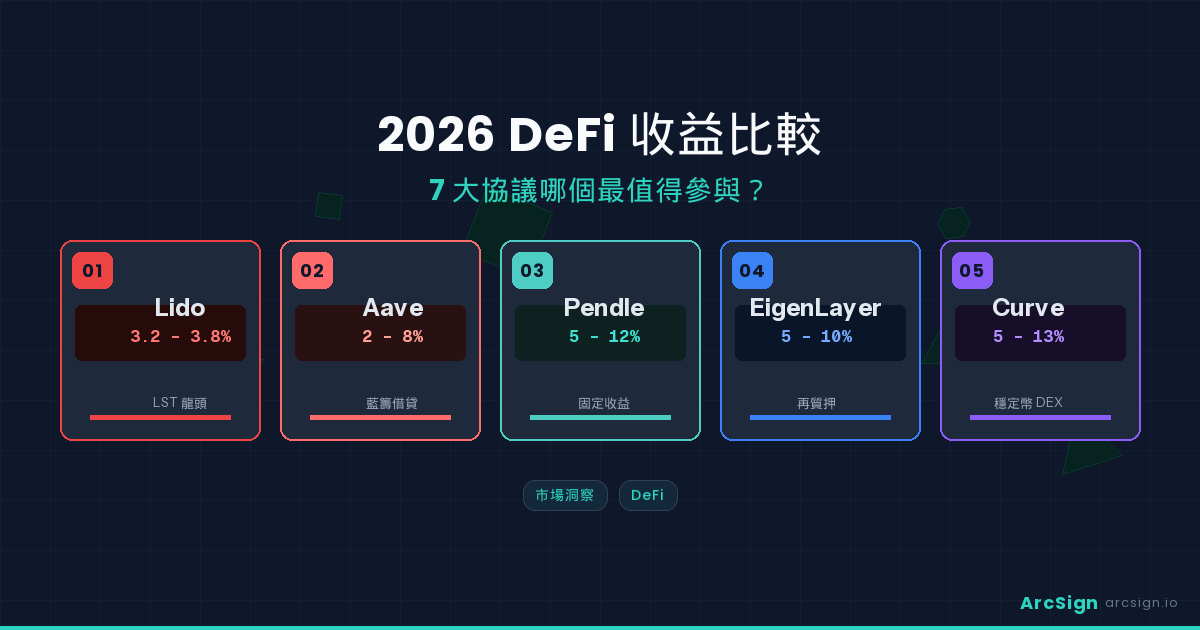
DeFi in 2026: Who Is Still Standing?
The madness of DeFi Summer 2020 is long gone. Back then, any random yield-farming protocol could advertise triple- or quadruple-digit APY — and most of them went to zero within six months. Fast-forward to 2026: after two full bull-bear cycles, DeFi looks very different. TVL is concentrated in blue-chip protocols, yields have normalized, and real revenue is now verifiable and transparent.
According to DefiLlama Q1 2026 data, global DeFi TVL sits around $180 billion, with the top 10 protocols commanding over 60% of it. Liquid staking (LST), lending, fixed income, and decentralized exchanges form the four pillars of DeFi yield. The “see 200% APY, ape in” era is over — today’s smart money cares about real yield: whether rewards come from genuine protocol revenue or just inflationary token emissions.
Three Big Shifts in 2026 DeFi
(1) Real revenue replaces token emissions — protocols distribute actual fee revenue; (2) Restaking rises — ETH stakers secure multiple networks for compound rewards; (3) Fixed-income markets mature — Pendle lets users lock in annualized rates like bonds.
The APY Reality: Why High Yields Are Often a Trap
Before evaluating any protocol, understand this: the APY you see and the return you actually receive can be wildly different numbers. Many beginners chase 50% APY, only to find three months later that their principal is down 40% — and discover too late that “high APY” was just a number.
Four Factors That Erode Real Returns
1. Token-Denominated Risk
Most high-APY protocols pay rewards in their own governance token. When markets turn or emissions accelerate, the reward token can crash. A protocol advertising “40% APY” may see its reward token drop 60% in a month, turning your real return into -30%. Only yields denominated in stablecoins or ETH are reasonably reliable.
2. Impermanent Loss (IL)
Liquidity providers often ignore this hidden cost. When the ratio of the two pool assets shifts, LP total value falls below simply holding both assets. In volatile pairs, IL can easily devour all trading-fee earnings.
3. Gas Fees
A single DeFi deposit on Ethereum mainnet can cost $20–$80 in gas. For a $1,000 account, round-trip gas alone eats over 10% of principal. Smaller accounts should prioritize L2 protocols on Arbitrum, Base, or Polygon.
4. Smart Contract Risk
DefiLlama tracked over $8 billion lost to DeFi exploits between 2020 and 2025. Any APY, no matter how attractive, becomes zero if the contract gets hacked. This is why blue-chip protocols with high TVL, multiple audits, and years of live operation often win on a risk-adjusted basis, even at lower headline yields.
Deep Dive: 7 Leading Protocols
Below are the 7 DeFi protocols most worth watching as of April 2026, spanning liquid staking, lending, fixed income, DEX, and restaking. All figures are snapshots from DefiLlama and each protocol’s official front end.
1. Lido — Liquid Staking Leader
TVL: ~$38B | APY: 3.2–3.8% (stETH) | Risk: Low
Lido is the undisputed leader in ETH staking. You deposit ETH, receive stETH, and stETH accrues staking rewards automatically while remaining freely usable across DeFi. Its key advantages: best liquidity and the broadest integrations — virtually every major DeFi protocol accepts stETH as collateral or liquidity. The weakness is node-operator concentration, which raises long-term decentralization concerns. If you pick only one LST in 2026, stETH still offers the smoothest overall experience.
2. Aave — The Blue-Chip Lending Market
TVL: ~$18B | APY: 2–8% (depending on asset) | Risk: Low
Aave v4 supports multi-chain deployment. USDC deposit rates sit at 3–5%, ETH at 1–3%. For conservative users, simply lending USDC is the most brain-dead reliable strategy. More advanced users can collateralize stETH, borrow USDC, and redeploy — building leveraged staking positions. Aave has years of live operation and multiple audits, making it the most trusted lending protocol today.
3. Pendle — The Fixed-Income Market
TVL: ~$7.5B | APY: 5–12% (PT, fixed), 30–200% (YT, variable) | Risk: Medium
Pendle splits yield-bearing assets into Principal Tokens (PT) and Yield Tokens (YT). Buying PT at a discount locks in a fixed annualized yield — e.g., paying $0.92 for a PT redeemable for $1 in one year locks in 8.7%. Buying YT is a bet on future yield — high risk, high reward. Conservative users buy PT; aggressive users buy YT. Pendle has deep markets on ezETH, rsETH, sUSDe, and other restaking and stablecoin assets.
4. EigenLayer — The Restaking Revolution
TVL: ~$15B | APY: 3–4% base + 2–6% AVS rewards | Risk: Medium
EigenLayer lets ETH stakers “re-rent” their security to other networks (AVSs), earning additional rewards on top of base staking. In theory you can stack multiple reward layers, but it also means stacked slashing risk. Dozens of AVSs are live today, though long-term economics are still being tested. Suited for users willing to accept more risk for excess returns.
5. Curve — The Stablecoin DEX Veteran
TVL: ~$3B | APY: 2–5% base + 3–8% CRV rewards | Risk: Low
Curve is the gold standard for stablecoin swaps. Its 3pool (USDC/USDT/DAI) and stETH-ETH pool are DeFi infrastructure. Providing liquidity here carries very little impermanent loss (the pooled assets barely diverge in price). Returns come from swap fees plus CRV emissions — a good fit for larger accounts seeking stable, low-risk yield.
6. Uniswap v4 — New Opportunities via Hooks
TVL: ~$5.5B | APY: highly variable (pool-dependent) | Risk: Medium
Uniswap v4 went live in late 2025, introducing Hooks that let developers customize liquidity strategies. Popular pairs (ETH/USDC, WBTC/ETH) have seen LP returns climb back to 8–15%, but impermanent loss risk is proportionally higher. Advanced users can deploy dynamic strategies through Hooks for outsized returns, but this isn’t beginner territory.
7. Morpho — Peer-to-Peer Lending Optimization
TVL: ~$4B | APY: 0.5–2% better than Aave | Risk: Low
Morpho adds a peer-to-peer matching layer on top of Aave and Compound: when borrower and lender demand can match directly, both sides get better rates than the underlying protocol. Effectively an Aave upgrade with the same risk profile but slightly higher yield. Morpho Blue (isolated lending markets) further allows anyone to spin up custom lending markets.
Yield, TVL, and Risk at a Glance
The table below summarizes the core metrics of all 7 protocols so you can decide quickly. Rates are early-April 2026 snapshots — actual figures shift with market conditions.
| Protocol | Category | APY Range | TVL ($B) | Risk |
|---|---|---|---|---|
| Lido | Liquid Staking | 3.2–3.8% | 38 | Low |
| Aave | Lending | 2–8% | 18 | Low |
| EigenLayer | Restaking | 5–10% | 15 | Medium |
| Pendle (PT) | Fixed Income | 5–12% | 7.5 | Medium |
| Uniswap v4 | DEX LP | 8–15% | 5.5 | Medium |
| Morpho | Lending Optimizer | 3–10% | 4 | Low |
| Curve | Stablecoin DEX | 5–13% | 3 | Low |
Risk-Adjusted Picks for Different Profiles
“Highest APY” isn’t “best choice.” A smart DeFi allocation depends on your risk tolerance, capital size, and time commitment. Here are three typical user profiles and suggested allocations.
Conservative (~80% of users)
Goal: stable returns, peace of mind. Suggested allocation: 40% Lido (stETH) + 40% Aave USDC + 20% Curve stETH-ETH pool. Expected 4–6% annualized, principal largely protected, and you get exposure to both ETH upside and steady interest.
Balanced (~15% of users)
Goal: higher returns while keeping principal mostly intact. Suggested allocation: 30% stETH + 30% Pendle PT + 25% EigenLayer restaking + 15% Morpho. Expected 7–10% annualized; you accept smart contract and liquidity risks but stay concentrated in blue-chip protocols.
Aggressive (~5% of users)
Goal: outsized returns, willing to lose part of principal. Suggested allocation: 40% blue-chip base + 30% Pendle YT + 20% Uniswap v4 LP + 10% early-stage protocols. Expected 15–50% annualized, but drawdowns beyond -30% are possible. Use only capital you can fully afford to lose.
The Golden Rule
Regardless of profile, follow the “blue-chip core, satellite exploration” principle: at least 60% of capital belongs in protocols like Lido, Aave, and Curve — 3+ years live, $3B+ TVL. Only the remainder should chase higher-yield newer opportunities.
Participating in DeFi From a Cold Wallet
The old belief was “cold wallets are for HODLing; DeFi needs a hot wallet.” That’s outdated. WalletConnect v2 + a USB cold wallet lets you interact smoothly with every major DeFi protocol while keeping your private keys offline.
Why DeFi Positions Belong in a Cold Wallet
Most DeFi losses don’t come from contract exploits — they come from compromised front ends, phishing approvals, and leaked private keys. When your funds are locked up earning yield in Lido or Aave for months, keeping your signing key in a hot wallet is like walking around town with your bank vault keys on a lanyard. A cold wallet ensures every approval requires the physical USB present; a malicious DApp cannot move your funds without your knowledge.
How ArcSign Connects to Major DeFi Protocols
1. Click “Connect Wallet” on Lido / Aave / Pendle
Choose WalletConnect. The site shows a QR code or a connection string. ArcSign supports WalletConnect v2 and connects to every EVM-compatible DeFi protocol.
2. Paste the Connection String Into the ArcSign Desktop App
Open ArcSign, go to the WalletConnect tab, and paste the string. ArcSign validates the DApp’s domain and origin to block man-in-the-middle attacks.
3. Sign Every Transaction Locally on the USB Device
When you stake or withdraw on the DApp, ArcSign shows a transaction preview with full calldata and target contract. Confirm on the USB to sign. The private key is exposed for only 1–5 milliseconds, protected by mlock memory locking.
4. Track DeFi Positions In-App
ArcSign’s DeFi positions page shows real-time APY for Lido (stETH), Ankr (ankrETH, ankrBNB), and other liquid staking tokens, so you can track your yield without juggling multiple websites.
Further Reading
Want to see how ArcSign manages DeFi assets across multiple chains with one mnemonic? Check our cross-chain guide — one seed manages 7 EVM chains. For an ETH staking walkthrough, see Earn Passive Income by Staking ETH with ArcSign.
Practical 2026 Allocation Suggestions
Based on everything above, here are concrete suggestions for different capital sizes. These are starting points — adjust based on your own research and risk tolerance.
Small Accounts ($1k–$10k)
Use Arbitrum or Base to avoid mainnet gas eating your returns. Suggested split: 70% stETH (bridged to Arbitrum) + 30% Aave USDC. Target 4–5% annualized — simple, stable, low-maintenance.
Mid-Sized Accounts ($10k–$100k)
Diversify further: 50% stETH + 20% Pendle PT (locked yield) + 20% Aave/Morpho USDC + 10% exploration slot (EigenLayer or newer protocols). Target 6–9% annualized. Rebalance every 3 months.
Large Accounts ($100k+)
Spread across protocols using a cold wallet: 40% Lido + 20% Aave + 15% EigenLayer + 15% Pendle + 10% Curve/Uniswap LP. Keep funds across at least two USB cold wallets (synced via encrypted .arcsign backups) to avoid single-device failure.
FAQ
Q: DeFi yields look huge — why do so many people still lose money?
Headline APY is just a number. Real returns depend on: token price volatility (most APYs are paid in native governance tokens, which often depreciate faster than the yield accrues), impermanent loss (hidden cost for liquidity providers when asset ratios shift), gas fees (frequent on-chain actions can eat small accounts alive), and smart contract risk (a single hack can zero out your principal). The smart play in 2026 is sticking to blue-chip protocols with high TVL, multiple audits, and yields denominated in stablecoins or ETH.
Q: Is using a cold wallet for DeFi safe? Isn’t it too inconvenient?
Using a cold wallet for DeFi is both safe and practical. ArcSign supports WalletConnect v2 and connects directly to Lido, Aave, Pendle, Curve, and other major protocols. Every transaction is signed locally on the USB device — private keys never leave cold storage. Compared to a hot wallet, the only extra steps are plugging in the USB and confirming each signature, which prevents malicious contracts or phishing sites from draining your assets. Long-term DeFi positions should almost always be protected by a cold wallet.
Q: Among stETH, rETH, and ankrETH, which liquid staking token is best in 2026?
Each has trade-offs. Lido’s stETH dominates market share and liquidity (nearly every DeFi protocol supports it), but Lido’s node concentration has raised decentralization concerns. Rocket Pool’s rETH uses more distributed operators — better if decentralization is a priority. Ankr’s ankrETH auto-compounds and also offers ankrBNB for BNB staking. If you can only pick one, stETH remains the best overall experience in 2026. If decentralization matters most, pick rETH. ArcSign’s DeFi positions page displays real-time APY for all three.
Q: What is the difference between Pendle’s “fixed yield” (PT) and “YT speculation”?
Pendle splits yield-bearing assets (like stETH) into two tokens. PT (Principal Token) represents the principal redeemable at maturity and trades at a discount — buying PT locks in a fixed annualized yield. YT (Yield Token) represents all yield accrued during the term — buying YT is a leveraged bet that future yields will rise. Conservative users buy PT to lock in returns; speculators buy YT for leveraged upside, knowing it can go to zero. The two sides form Pendle’s unique fixed-income market.