What Is Gas Fee? Starting With EIP-1559
Gas Fee is the computational fuel cost you pay for every on-chain operation. Every transaction, every contract interaction requires validators to spend resources including it in a block. Gas Fees compensate them for that cost.
Since the London upgrade introduced EIP-1559 in 2021, Ethereum’s fee market has two parts:
-
Base Fee: Auto-adjusted by the protocol based on recent block fullness — raised if the previous block was more than 50% full, lowered otherwise. The Base Fee is burned.
-
Priority Fee (tip): User-set amount paid directly to validators; higher tips get included faster.
Total Gas Fee = (Base Fee + Priority Fee) × Gas Used. Gas Used depends on the complexity of the operation: a plain transfer is about 21,000 gas, a DEX swap is typically 150,000-300,000 gas, and a complex NFT mint can exceed 500,000 gas.
Three Levers You Actually Control
You can’t change the Base Fee, but you can control: (1) when you send the transaction, (2) the Priority Fee you’re willing to pay, and (3) which chain you operate on. Every gas-saving strategy flows from these three levers.
Why Gas Fees Swing So Wildly
Gas prices behave like a mini stock market — driven by supply, demand, and events. The usual culprits behind spikes:
-
Hot NFT mints: Tens of thousands of users compete for block space in minutes — gas can spike 10x.
-
Airdrop claims: On claim day for a major project, gas often blows past 200 Gwei.
-
Liquidation cascades: Sharp market drops trigger DeFi liquidation bots bidding against each other.
-
MEV bots: Front-runners, sandwich bots, and arbitrage bots are always bidding for block space.
-
Stablecoin de-peg events: When UST, USDC, or similar briefly depeg, everyone tries to rotate at once.
Once you recognize these patterns, you can judge whether to send now, or whether waiting two hours drops gas by 70%.
The 8 Savings Strategies at a Glance
Ordered from highest to lowest impact — from “change chains entirely” to “fine-tune parameters”:
| # | Strategy | Typical Savings | Best For |
|---|---|---|---|
| 1 | Pick the right time window | 30-70% | Non-urgent transactions |
| 2 | Manually tune Priority Fee | 10-40% | Patient transfers |
| 3 | Migrate to Layer 2 (Arbitrum / Optimism / Base) | 90-98% | HODL + frequent activity |
| 4 | Use low-fee chains (Polygon / BSC) | 95-99% | Stablecoin transfers, small swaps |
| 5 | ArcSign built-in DEX smart routing | 5-25% | Token swaps |
| 6 | Batch Token Approval revokes | 40-60% | Approval cleanup |
| 7 | Custom RPC endpoint | Reliability ↑ | Avoiding failed tx costs |
| 8 | Exploit L2 batching (e.g. Arbitrum sequencer compression) | Continuous | L2 transactions |
Strategy 1-2: Timing & Priority Fee
Strategy 1: Send at the Right Time
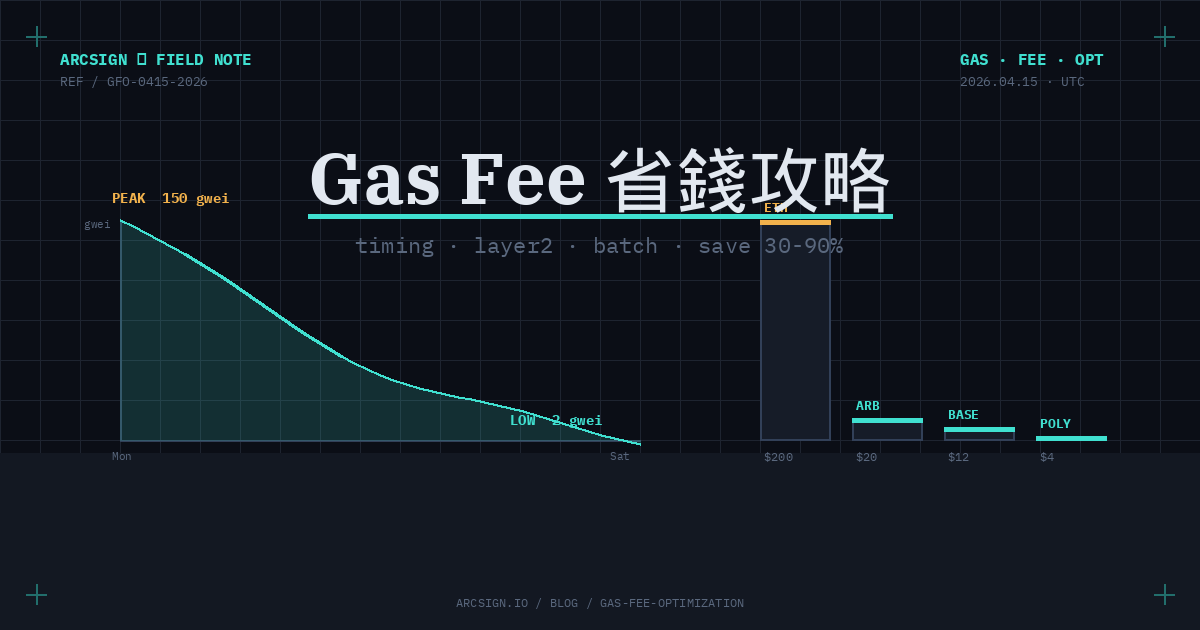
Based on two years of on-chain data, Ethereum mainnet gas typically hits lows during:
-
Saturday 00:00-08:00 UTC: US/EU markets offline, Asia weekend still quiet. The calmest window of the week.
-
Sunday 05:00-12:00 UTC: Same logic.
-
Weekday 04:00-08:00 UTC: US East Coast asleep, Europe just starting.
Conversely, avoid weekday 13:00-22:00 UTC — US East Coast daytime overlapping with European close. That’s when DeFi, NFTs, and MEV activity concentrate.
Pro Tip
In ArcSign, the Dashboard → Gas Tracker panel shows real-time Base Fee and the last 24 hours’ trend. Making it a habit to “glance before you sign” adds up to serious savings over time.
Strategy 2: Match Priority Fee to Urgency
Most wallets default Priority Fee to 1-3 Gwei, but many transactions don’t need instant inclusion. Split them into three tiers:
1. Low priority (30-60 min OK)
Set Priority Fee to 0.01-0.1 Gwei. Off-peak, most land within an hour. Good for non-urgent transfers, DCA strategies, and long-horizon moves.
2. Standard (5-15 min)
Priority Fee 1-2 Gwei. ArcSign’s default — good for everyday swaps, transfers, and DApp interactions.
3. High priority (liquidation rescue, NFT mint)
Priority Fee 5-20+ Gwei. Only use when instant inclusion is truly critical.
Strategy 3-4: Layer 2 & Multi-Chain
Strategy 3: Migrate to Layer 2
L2 is the single most effective gas-saving move in 2026. Major L2s like Arbitrum, Optimism, Base, and zkSync use transaction compression and batched settlement to squeeze thousands of transactions into a single mainnet write — average cost is just 1-5% of mainnet.
ArcSign natively supports the major EVM L2s: pick the chain from the network switcher and operate with the same cold wallet. Common picks:
-
Arbitrum One: Deepest DeFi liquidity on any L2 — GMX, Camelot, Pendle all live here.
-
Base: Coinbase’s L2. Fast-growing ecosystem, strong for stablecoins and memecoins.
-
Optimism: Home of Velodrome and Synthetix, with extremely low fees.
-
zkSync Era: Zero-knowledge rollup, one of the most cryptographically secure L2 paths.
Strategy 4: Pick a Low-Fee Chain for Stablecoin Ops
For small stablecoin transfers and routine swaps, non-L2 alternatives are equally cheap:
-
Polygon PoS: USDC/USDT transfers around $0.01 — ideal for merchant payments.
-
BNB Smart Chain: PancakeSwap’s home ground; swap fees usually
Risk Reminder
L2s and alternative chains come with their own trust assumptions: sequencer centralization, bridge contract risk, validator concentration. Keep large holdings on mainnet inside your cold wallet and migrate day-to-day operations and experimental positions to L2. ArcSign lets you manage 7 chains from a single seed phrase, making a layered storage strategy easy.
Strategy 5-8: ArcSign in Practice
Strategy 5: ArcSign Built-In DEX Smart Routing
ArcSign integrates the OpenOcean + KyberSwap dual aggregator. When you initiate a swap, it compares both aggregator quotes and automatically chooses the path that delivers the highest net output after gas. Versus doing it yourself on any single DEX, the aggregator typically saves an extra 5-25% — especially on long-tail pairs or large trades.
The key point: ArcSign takes zero extra fees. The gas you see is exactly what the chain charges. Every dollar of savings returns to your wallet.
Strategy 6: Batch Token Approval Management
Every time you use a new DApp, you grant token approvals to its smart contract. If you never clean them up, they become a persistent attack surface — “drainer” exploits exploit exactly this. But revoking one by one is expensive: ~30-50k gas each.
ArcSign’s token approvals dashboard shows all approvals across 6 EVM chains. Pro members can multi-select and batch revoke in a single transaction, cutting total gas 40-60% versus one-at-a-time revokes. Safer and cheaper at once.
Strategy 7: Custom RPC Endpoint
Free public RPC endpoints (like default Infura public endpoints) tend to lag or return stale data during congestion. That leads to wrong nonces, bad gas estimates, and failed transactions — and failed transactions still burn gas with no refund.
In ArcSign’s Settings → Custom RPC, you can paste your own Alchemy, QuickNode, or self-hosted endpoint. The free Alchemy tier is plenty for personal use: its private endpoint rarely stalls, dramatically cutting the hidden cost of re-sending failed transactions.
Strategy 8: Exploit L2 Batching & WalletConnect v2
L2 sequencers (Arbitrum, Base, etc.) batch and compress transactions to mainnet. The more transactions in a batch, the lower each individual cost. Counterintuitively, busy L2 windows can sometimes cost less per transaction than quiet ones, because compression amortizes better.
Pair that with ArcSign’s WalletConnect-dapp-tutorial.html” style=“color:var(—primary);“>WalletConnect v2 and you can drive Rabby, OKX Wallet, or any WalletConnect-enabled DApp from mobile, while ArcSign signs from cold storage. Cheap L2 operations plus cold-wallet security — and the private key never leaves your USB device.
Gas Cost Comparison Across Chains
Average USD cost for common operations as of April 2026 (estimates, market-dependent):
| Chain | Plain Transfer | DEX Swap | Token Approval | NFT Mint |
|---|---|---|---|---|
| Ethereum Mainnet | $2-8 | $15-60 | $3-10 | $30-200 |
| Arbitrum One | $0.05-0.20 | $0.30-1.50 | $0.10-0.40 | $0.50-3 |
| Base | $0.02-0.15 | $0.20-1.00 | $0.05-0.30 | $0.30-2 |
| Optimism | $0.03-0.20 | $0.25-1.20 | $0.08-0.35 | $0.40-2.50 |
| Polygon PoS | $0.01-0.05 | $0.05-0.30 | $0.02-0.10 | $0.10-1 |
| BNB Smart Chain | $0.10-0.30 | $0.20-0.80 | $0.15-0.40 | $0.50-3 |
The table makes it obvious: simply switching chains cuts 95%+ off your fees. That’s why we recommend a layered architecture — mainnet cold storage for the bulk of holdings, L2/alt-chain for daily activity.
Related Reading
Want to go deeper on multi-chain operations? See: Cross-Chain Made Easy: Managing 7 EVM Chains with ArcSign, Swap Tutorials on Polygon & BSC, and ETH + BSC + Polygon in One Place.
FAQ
Q: Why do gas fees fluctuate so much?
Ethereum uses EIP-1559: the Base Fee auto-adjusts to recent block congestion, while the Priority Fee is a user-set tip. Whenever an on-chain event spikes demand (airdrops, NFT mints, liquidations), gas climbs. Different chains behave very differently — Polygon and BSC average 1-5% of Ethereum mainnet gas, while L2s like Arbitrum, Optimism, and Base fall somewhere in between.
Q: How much can ArcSign save me on gas?
ArcSign itself charges zero extra fees — 100% of what you pay goes to the chain’s validators. Through custom RPC endpoints, multi-chain support, the built-in DEX aggregator (OpenOcean + KyberSwap), and WalletConnect v2, users typically save 30-90% per transaction. The exact savings depend on your timing, target chain, and batching opportunities.
Q: When is the cheapest time to send a high-gas transaction?
Saturday 00:00-08:00 UTC is consistently the quietest window on Ethereum mainnet — gas often drops to 30-40% of peak levels. Avoid weekday 13:00-22:00 UTC, when US East Coast daytime overlaps with European close: that’s when DeFi, NFT, and MEV activity concentrate. If you’re not in a hurry, set Priority Fee to 0.01-0.1 Gwei in ArcSign and let the transaction drift into a block over 1-3 hours.
Q: Is Layer 2 really cheaper than Ethereum mainnet? What are the risks?
Yes. Rollups like Arbitrum, Optimism, Base, and zkSync compress many transactions into a single mainnet settlement, so average fees are 1-5% of mainnet. Main risks: sequencer centralization (most run a single node today), L2 bridge smart-contract risk, and withdrawal delays (Optimistic Rollups require a 7-day challenge period). For long-term holding and frequent small transactions, L2s are excellent; large cross-chain transfers and final settlement often still belong on mainnet.