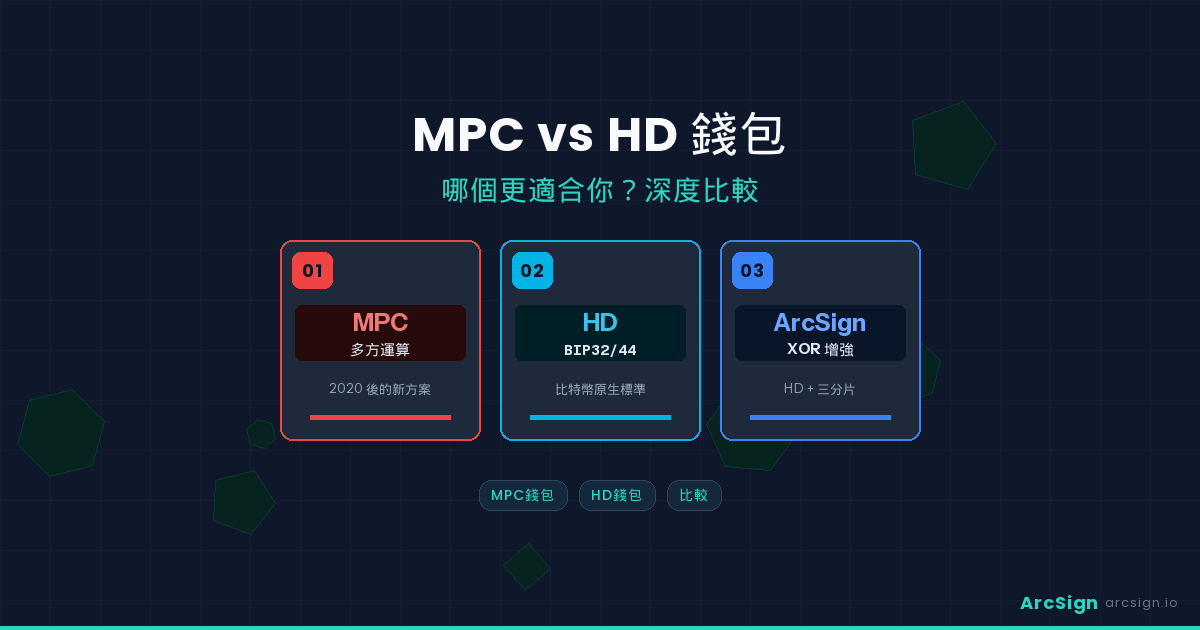
Why This Comparison Matters
If you’ve been researching crypto wallets, you’ve likely encountered “MPC wallet” and “HD wallet” repeatedly. Over the past few years, MPC (Multi-Party Computation) has been marketed by many institutions and startups as “next-generation wallet technology,” implying that traditional HD (Hierarchical Deterministic) wallets are outdated.
But is that really the case? Before you entrust your crypto assets to any wallet, you need to understand the core differences between these two approaches — not just the marketing pitch, but the underlying security architecture, recovery mechanisms, and real-world use cases. This article will help you make the right choice for your situation.
Key Takeaway
MPC vs HD isn’t about “which is better” — it’s about “which is better for your specific use case.” The best choice for individual users and institutions may be completely different.
What Is an HD Wallet? BIP-39/44 Explained
HD stands for Hierarchical Deterministic, defined by BIP-32 and later enhanced by BIP-39 (mnemonic standard) and BIP-44 (multi-currency path standard). This is by far the most widely adopted wallet architecture — from MetaMask to Ledger, nearly every major wallet uses this standard.
How It Works
An HD wallet starts with a set of 12 or 24 English words (seed phrase/mnemonic). Through a series of deterministic mathematical derivations, it generates a “key tree.” Each branch corresponds to a blockchain account, and each account maps to a unique private key and public key pair.
1. Generate Seed Phrase
A cryptographically secure random number generator (CSPRNG) produces 128/256 bits of entropy, converted into 12/24 English words.
2. Derive Master Key
The seed phrase is processed through PBKDF2-HMAC-SHA512 to produce a 512-bit seed, from which the master private key and chain code are derived.
3. Derive Child Keys
Following BIP-44 paths (e.g., m/44’/60’/0’/0/0), child keys are derived layer by layer for each blockchain. One seed phrase manages BTC, ETH, BSC, and all other accounts.
The greatest advantage of HD wallets is standardization and cross-platform compatibility. A seed phrase generated in ArcSign can be recovered in MetaMask, Trust Wallet, or any BIP-39 compatible wallet. You’re never locked into a single vendor.
What Is an MPC Wallet? Multi-Party Computation Simplified
MPC wallets use Multi-Party Computation technology. The core idea: split the private key into multiple fragments distributed among different parties. When signing, all parties collaborate computationally, but no single party ever knows the complete private key.
How It Works
Unlike HD wallets, MPC wallets never generate a complete private key. Instead, they use a Distributed Key Generation (DKG) protocol:
1. Distributed Key Generation
Multiple parties (e.g., user device + cloud server + recovery server) each generate their own key fragment. A mathematical protocol ensures these fragments correspond to the same public key, but no one holds the complete private key.
2. Collaborative Signing
When you want to send a transaction, each party participates in a multi-round communication protocol to jointly compute a valid digital signature — without revealing their individual fragments.
3. Threshold Mechanism
Typically designed as a T-of-N threshold scheme (e.g., 2-of-3): out of N fragment holders, only T need to agree for signing. This provides redundancy and fault tolerance.
Notable MPC wallet products include Fireblocks (institutional), Zengo (consumer), and Coinbase’s MPC wallet service. MPC excels in institutional custody and enterprise multi-party management scenarios.
Important Note
MPC sounds cutting-edge, but its security assumptions differ fundamentally from HD wallets. It requires multiple nodes to be online and communicating, meaning you must trust that the MPC service provider won’t shut down, get hacked, or be compelled to hand over data.
Security Architecture: Which Resists Attacks Better?
HD Wallet Security Model
A traditional HD wallet’s security hinges on one critical element: the safety of the seed phrase. If the seed phrase is compromised, all assets are exposed. This is indeed a single point of failure.
However, this problem can be dramatically mitigated through technology. Take ArcSign as an example — it adds multiple layers of protection on top of the HD architecture:
XOR Three-Shard Encryption — The private key is never stored whole on the USB. It’s split into three XOR fragments. Even if the USB is stolen, the attacker gets only three pieces of random data. mlock-memory-protection.html” style=“color:var(—primary);“>mlock Memory Protection — During signing, the private key exists in memory for only 1-5 milliseconds, protected by mlock to prevent swapping to disk. AES-256-GCM Encryption — Each fragment is additionally encrypted with AES-256, creating dual-layer protection.
MPC Wallet Security Model
The MPC security model eliminates single points of failure — no single party possesses the complete private key. In theory, this is a significant advantage. But it also introduces new attack surfaces:
Communication Protocol Risk — MPC signing requires multiple rounds of communication, each one a potential attack vector. If an attacker can eavesdrop on or tamper with communications, key leakage becomes possible. Service Provider Dependency — Most consumer MPC wallets depend on the provider to maintain one of the key fragments. If the provider shuts down, gets hacked, or is ordered to surrender data, your assets could be at risk. Protocol Complexity — MPC cryptographic protocols are extremely complex, making implementation bugs harder to detect and audit. Multiple MPC implementations have historically been found to contain security vulnerabilities.
Backup & Recovery: Which Is More Reliable?
HD Wallet: Seed Phrase + Encrypted Backup
HD wallet recovery is straightforward: with your seed phrase, you can recover all accounts anytime, anywhere. This is the cross-platform interoperability that BIP-39 provides. You don’t need to contact any company, pass any verification — 12 English words are your ultimate recovery tool.
ArcSign goes further with .arcsign encrypted backup files. This file contains your complete wallet information, encrypted with AES-256-GCM — export equals encryption, no separate password setup needed. Store it on a second USB drive; even if someone else gets it, they can’t decrypt it.
MPC Wallet: The Challenge of Fragmented Recovery
MPC wallet recovery is far more complex. Since the private key never exists in complete form, you can’t simply “write down a seed phrase” to back up. Recovery typically requires:
Multi-party collaboration — You need your key fragment plus the provider’s fragment to recover. Proprietary process — Each MPC wallet has its own recovery flow, usually requiring identity verification. Provider availability — If the provider goes out of business or experiences system failure, recovery may become extremely difficult or impossible.
The Critical Difference
HD wallet recovery is self-sovereign — you don’t need any third party. MPC wallet recovery is collaborative — you must depend on other participants. In the “Not your keys, not your coins” philosophy of cryptocurrency, this is a fundamental trade-off.
User Experience & Use Cases
HD Wallet: Best For
Personal self-custody — You want complete control over your assets with zero third-party dependency. Multi-chain management — One seed phrase manages ETH, BSC, Avalanche, and more. ArcSign supports 7 EVM chains. Offline security — Paired with USB cold storage, the entire signing process stays offline, minimizing the attack surface. Long-term holding — Seed phrases and .arcsign backups can be preserved for decades, unaffected by any company’s fate.
MPC Wallet: Best For
Enterprise fund management — Multi-person approval, layered permissions, compliance auditing. Institutional custody — The institutional-grade security and insurance that funds and exchanges require. Seedless experience — For users unfamiliar with crypto, MPC can provide a Web2-like login experience. High-frequency trading — Enterprise MPC services typically integrate fast signing and APIs.
Full Comparison Table: At a Glance
| Dimension | HD Wallet | MPC Wallet | ArcSign (HD + Enhanced) |
|---|---|---|---|
| Private Key Form | Stored complete locally | Never exists complete | XOR three-shard storage |
| Single Point of Failure | Seed phrase leak = total loss | No single party can steal | Three-shard + encryption eliminates |
| Backup & Recovery | Seed phrase — cross-platform | Requires provider collaboration | Seed phrase + .arcsign backup |
| Offline Signing | Supported | Requires multi-party online comms | USB fully offline |
| Third-Party Dependency | Fully self-sovereign | Depends on MPC provider | Fully self-sovereign |
| Cross-Platform Compat. | BIP-39 universal standard | Proprietary, non-interoperable | BIP-39/44 standard |
| Multi-Chain Support | BIP-44 native support | Depends on provider | 7 EVM chains |
| Memory Protection | Most don’t implement | Depends on implementation | mlock + 1-5ms exposure window |
| Cost | Mostly free | Enterprise plans are expensive | Completely free |
| Best For | Individual users, long-term holders | Enterprises, institutional custody | Individual to advanced users |
The ArcSign Approach: HD Wallet + Multi-Layer Security
ArcSign chose the HD wallet architecture (BIP-39/BIP-44) because it provides maximum self-sovereignty and cross-platform compatibility. But we didn’t stop at the standard HD implementation — we layered multiple security enhancements on top, making it match or exceed MPC solutions in security:
1. XOR Three-Shard Encryption
The private key is split into three XOR fragments on the USB — information-theoretically unbreakable. Even if the USB is stolen, the attacker gets only random data. Learn about XOR three-shard →
2. mlock Memory Protection
During signing, the private key exists in protected memory for only 1-5 milliseconds, never swapped to disk or captured by malware. Learn about mlock protection →
3. AES-256-GCM Dual-Layer Encryption
Each XOR fragment is further encrypted with AES-256-GCM, creating a “fragment encryption + overall encryption” dual-layer defense.
4. USB Offline Cold Storage
From key generation to signing, everything happens on the USB — completely air-gapped. With WalletConnect v2, you can even interact with DApps securely from cold storage.
5. .arcsign Encrypted Backup
Export-equals-encrypted backup files, more secure than paper seed phrases. Store on a second USB — even if someone else gets it, they can’t decrypt it. Learn USB backup strategy →
The result: you get all the convenience of an HD wallet (standard seed phrase, cross-platform compatibility, multi-chain support) with security that exceeds most MPC wallets — and it’s completely free. Learn how to protect your private keys properly regardless of wallet architecture.
Bottom Line
MPC wallets solve the “private keys shouldn’t exist in one place” problem, but at the cost of third-party dependency and communication complexity. ArcSign achieves the same security goal with XOR three-shard + USB cold storage — the private key never exists in complete form — but with zero third-party dependency.
Frequently Asked Questions
Q: Are MPC wallets more secure than HD wallets?
Not necessarily. MPC wallets eliminate single points of failure but introduce communication protocol complexity and multi-node coordination risks. An HD wallet with USB cold storage (like ArcSign’s XOR three-shard + mlock protection) can provide equal or greater security in an offline environment, with zero network dependency.
Q: Is the seed phrase a security weakness for HD wallets?
Traditionally, the seed phrase is indeed a single point of failure for HD wallets. However, ArcSign addresses this through XOR three-shard encryption that splits the private key into three fragments, plus .arcsign encrypted backup files (AES-256-GCM), fundamentally solving the paper backup security problem.
Q: As an individual user, should I choose MPC or HD?
For individual users, HD wallets are typically the better choice. They’re simple to use, fully self-sovereign, and don’t require any third-party service to be online. With ArcSign USB cold storage, you get institutional-grade security at zero cost. MPC wallets are better suited for enterprise or institutional multi-party management scenarios.
Q: What wallet architecture does ArcSign use?
ArcSign uses HD wallet architecture (BIP-39/BIP-44 standards) enhanced with XOR three-shard encryption, mlock memory protection, and AES-256-GCM dual-layer encryption. This gives you the convenience and cross-platform compatibility of HD wallets with security that exceeds traditional HD implementations.