Where Does the “Security = Paid” Myth Come From?
In the crypto world, there’s a deeply rooted belief: “Good security costs money.” Ledger sells for $79, Trezor for $69, Keystone for $149 — these price tags implicitly create a psychological suggestion: the more expensive the wallet, the safer it is, and anything free must have something wrong with it.
This myth stems from two cognitive biases. The first is the “price = quality” heuristic — we’re conditioned by everyday life to believe “you get what you pay for,” but in the world of software and cryptography, this rule doesn’t hold. The second is hardware wallet brands’ marketing strategies. They deliberately emphasize impressive-sounding hardware features like “secure element chips” and “military-grade certification,” making consumers believe these hardware components are the sole source of security.
Looking for a specific recommendation? See our guide to the best free cold wallet in 2026 — a free, open-source alternative to Ledger and Trezor.
But here’s the truth: a crypto wallet’s security comes from cryptographic algorithms and software architecture, not price tags. The AES-256 encryption, ECDSA digital signatures, and BIP-39 mnemonic standards you use are all public, free cryptographic technologies. No paid wallet has “invented” a more secure encryption algorithm — they use the same math as free wallets.
Core Insight
Security is an engineering problem, not a pricing problem. Linux is free, yet powers 90% of the world’s servers. Signal is free, yet is recognized by cryptographers as the most secure messaging app. The value of security software comes from its architectural design, not its commercial pricing.
Dissecting the Paid Hardware Wallet Business Model
To understand whether “free can be secure,” let’s first examine what paid hardware wallets are actually selling. When you break down the cost structure of hardware wallets like Ledger and Trezor, you’ll find:
Why Did You Pay $79?
A secure element chip costs approximately $2–5. The screen, casing, buttons, and other hardware materials run about $10–15. Add assembly, packaging, and shipping, and the total hardware cost is roughly $20–30. The remaining $50+ pays for brand premium, marketing expenses, distribution margins, and profit.
In other words, most of what you pay for isn’t “security” — it’s the brand and hardware. The secure element chip does provide a layer of hardware isolation, but it’s not the entirety of security — and it may not even be the most important part.
The Security Concerns of Hardware Wallets
Ironically, some business decisions by hardware wallet makers have introduced new security risks. The 2023 Ledger Recover incident is the perfect example: Ledger launched a “cloud backup” service that uploads encrypted fragments of users’ mnemonics to third-party servers. This means their firmware technically has the capability to extract users’ private keys — directly contradicting their core promise that “private keys never leave the device.”
Additionally, hardware wallets face supply chain attack risks: during manufacturing and shipping, devices could be intercepted and implanted with backdoors. Is the Ledger you received identical to the one that left the factory? This is a question consumers can never independently verify.
Food for Thought
If the secure element chip were the sole guarantee of security, why could Ledger bypass it through a firmware update to extract users’ private keys? This tells us: hardware is just one layer of security — software architecture and trust models are what truly matter.
Security Depends on Architecture, Not Price
In cryptography, there’s a fundamental principle known as Kerckhoffs’s Principle: a cryptographic system’s security should not depend on keeping the system secret, but only on keeping the key secret. In other words, even if an attacker fully understands your encryption algorithm, as long as they don’t know your key, your assets are safe.
An important corollary of this principle is: security doesn’t require “payment” to achieve. The world’s strongest encryption algorithms (AES, RSA, ECDSA, SHA-256) are all open standards. Anyone can use them for free, and anyone can audit them for free. In fact, it’s precisely because they’re open, transparent, and vetted by countless cryptographers that we can trust them.
The Three Security Dimensions That Actually Matter
1. Private Key Storage Method
How is the private key stored? Plaintext or encrypted? Single file or sharded? On a connected device or in offline storage? These design decisions determine how difficult it is to steal the private key.
2. Private Key Protection During Use
When signing transactions, the private key must be briefly accessed. The protective measures during this process — memory locking, zero-wiping, exposure time control — are critical security factors.
3. Backup and Recovery Mechanism
Is the backup encrypted? Is the recovery process secure? These often-overlooked aspects are frequently the actual weakest links in security.
Notice: none of these three dimensions require money to do well. They’re all questions of software architecture and applied cryptography, completely unrelated to product pricing.
ArcSign’s Four-Layer Security Architecture
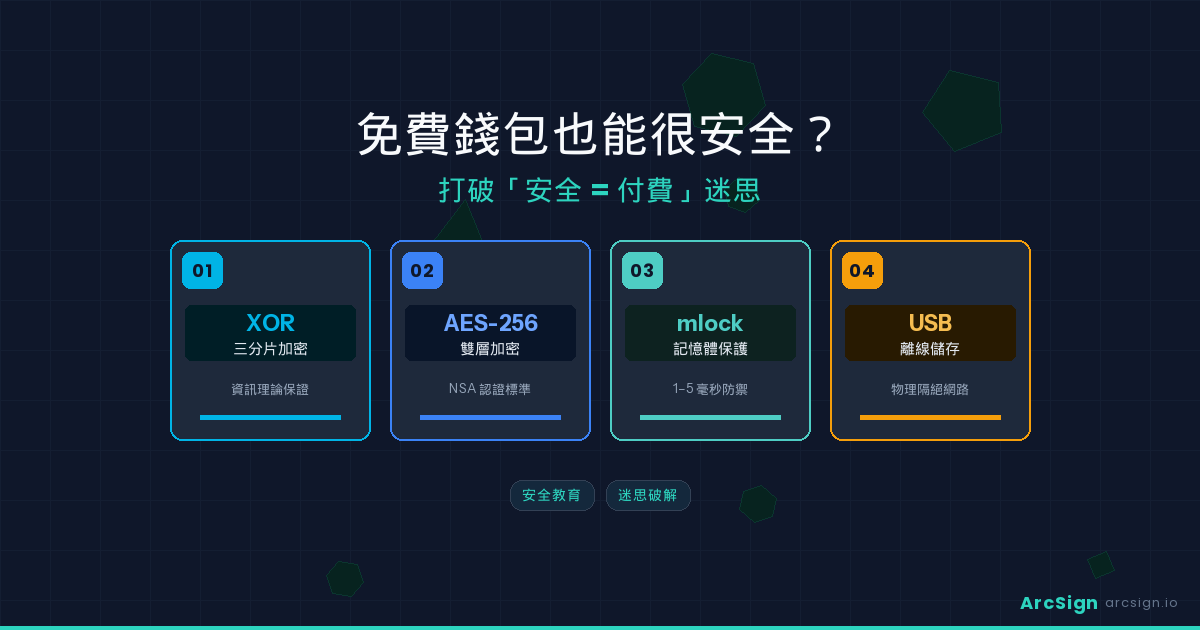
As a free USB cold wallet, how does ArcSign deliver top-tier security without charging a cent? The answer lies in four interlocking security layers:
1. XOR Three-Shard Encryption — Private Key Never Exists Whole
ArcSign splits your private key into three random shards (Shard A, B, C) using cryptographically secure XOR operations. No single shard contains any information about the original private key. This is backed by an information-theoretic mathematical guarantee, not marketing speak.
2. AES-256-GCM Double-Layer Encryption — Each Shard Re-Encrypted
Each of the three shards is further encrypted with AES-256-GCM + Argon2id before being stored on the USB drive. Even if an attacker obtains the USB, they’re facing double-encrypted random data. AES-256 is the highest-grade encryption standard approved by the NSA.
3. mlock Memory Protection — Millisecond-Level Defense During Signing
During transaction signing, the private key exists only in mlock-protected memory for 1–5 milliseconds. This memory block is never swapped to disk, and is immediately overwritten with zeros after signing completes. An attacker would need to breach the operating system’s memory protection within a millisecond-level time window — practically impossible.
4. USB Offline Storage — Physical Isolation from Network Attacks
All encrypted data is stored on a USB flash drive — no internet connection, no cloud, no servers involved. No matter how skilled a remote hacker is, they cannot reach your private key through the network. This is the fundamental security difference from hot wallets like MetaMask or Trust Wallet.
Security Equation
XOR Three-Shard + AES-256-GCM Double Encryption + mlock Memory Protection + USB Offline Storage = Four-Layer Defense. All of these technologies are open cryptographic standards. They don’t require proprietary hardware or paid licenses. ArcSign integrates them into a free, user-friendly product.
Free vs Paid Wallets: A Comprehensive Comparison
Let’s put ArcSign (free) side by side with mainstream paid hardware wallets for an objective comparison:
| Feature | ArcSign (Free) | Ledger Nano (~$79) | Trezor Model T (~$169) |
|---|---|---|---|
| Price | ✓ Free | $79 USD | $169 USD |
| Key Storage | ✓ XOR 3-shard + AES-256 | Secure Element | General MCU |
| Memory Protection | ✓ mlock (1-5ms exposure) | ✓ SE isolation | Limited |
| Supported Chains | ✓ 7 EVM chains | ✓ 5000+ coins | ✓ 1000+ coins |
| Built-in DEX Swap | ✓ OpenOcean + KyberSwap | Via third party | Via third party |
| WalletConnect v2 | ✓ Native support | Via Ledger Live | Limited support |
| Backup Method | ✓ Encrypted .arcsign file + mnemonic | Mnemonic (paper) | Mnemonic (paper) |
| Supply Chain Risk | ✓ None (generic USB) | Yes (proprietary HW) | Yes (proprietary HW) |
| Firmware Backdoor Risk | ✓ None (no firmware) | Yes (Ledger Recover) | Lower (open firmware) |
| Code Transparency | ✓ Fully open source (Apache 2.0) | Closed firmware | ✓ Fully open-source |
As the comparison shows, ArcSign matches or exceeds paid solutions in key areas like private key protection, backup mechanisms, and supply chain security. Its relative weakness is fewer supported coins (focused on 7 major EVM chains) — but this is a development-stage limitation, not an architectural security flaw.
Open Transparency vs Closed Trust: Which Is Safer?
In security, there’s a crucial question that’s often overlooked: do you trust mathematics, or do you trust a brand?
Paid hardware wallets ask you to trust their secure element chips, their firmware, and their supply chains. But none of these can you independently verify. You can only believe Ledger when they say “we won’t do anything malicious” — and then Ledger Recover showed the world that their firmware actually can extract your private keys.
ArcSign chose a different trust model: trust math, not brands. XOR’s security is provable through information theory. AES-256’s strength is recognized by global cryptographic consensus. mlock’s behavior is explicitly documented in operating system specifications. You don’t need to “trust” the ArcSign team — you just need to trust public mathematics and standards.
Security Exemplars in the Open-Source World
If you still think “free = insecure,” consider these examples: Linux is free and open-source, powering over 90% of the world’s servers and cloud infrastructure. Signal is free and open-source, recommended by journalists, human rights workers, and cryptographers as the most secure messaging tool. Bitcoin Core is free and open-source, securing a multi-trillion-dollar Bitcoin network.
These cases all prove one thing: software security comes from architectural design and community auditing, not price tags. ArcSign is fully open source under Apache 2.0, so global developers can audit and verify its security (source at github.com/arcsignio/arcsign).
ArcSign’s Transparency Commitment
ArcSign has already published full technical details of its security architecture and encryption schemes. All code is fully open source under Apache 2.0, achieving fully transparent security verification. Users can also independently verify ArcSign’s security claims through the encryption behavior of .arcsign backup files and on-chain verifiability of signatures.
Real-World Cases: Paid ≠ Secure
Finally, let’s look at several real-world cases proving that “paid” and “secure” don’t have a causal relationship:
Case 1: Ledger Recover Controversy (2023)
Ledger launched its Recover service, enabling the device to upload encrypted mnemonic fragments to third-party servers through a firmware update. The community was shocked to discover: Ledger’s firmware had always been capable of extracting private keys. That $79 secure element chip didn’t prevent the manufacturer from being able to “do the wrong thing.”
Case 2: Trezor Physical Attack Vulnerability (2020)
Security researchers at Kraken Security Labs demonstrated how to extract mnemonics from a Trezor device within 15 minutes through physical access. This $169 device offered virtually no resistance to physical attacks.
Case 3: Free Software’s Security Track Record
Conversely, free software has a stellar security track record. OpenSSL (free) protects over 70% of the world’s HTTPS communications. WireGuard (free) was adopted by the Linux kernel as the most secure VPN protocol. VeraCrypt (free) is one of the world’s most trusted disk encryption tools.
Conclusion
Price is neither a guarantee nor a prerequisite for security. True security comes from transparent architecture, verified cryptography, and rigorous engineering practices. ArcSign Proves one thing: you don’t need to spend $79 to protect your crypto assets — you need the right technical architecture.
FAQ
Q: Is a free crypto wallet really safe? Are there hidden risks?
Security depends on technical architecture, not price. ArcSign uses XOR three-shard encryption, AES-256-GCM double-layer encryption, and mlock memory protection — all cryptographically proven technologies that deliver security on par with or even exceeding paid hardware wallets. Free doesn’t mean cutting corners. ArcSign’s business model funds development through optional Pro NFT memberships for advanced features, while keeping all core security features completely free.
Q: ArcSign is free and has no secure element chip — is it less safe than Ledger/Trezor?
Not necessarily. A Secure Element (SE) does provide hardware-level isolation, but it also introduces supply chain risks and firmware backdoor concerns (e.g., the Ledger Recover controversy). ArcSign replaces the SE with software-level XOR three-shard encryption + mlock memory protection. The advantages: fully transparent and verifiable technology, no dependency on a single hardware vendor, and a private key exposure window of only 1–5 milliseconds. These represent different security philosophies, not a simple better-or-worse comparison.
Q: If ArcSign is free, how do they make money? Will they sell my data?
ArcSign never collects or sells user data. Its business model relies on optional Pro NFT memberships (offering batch approval revocation, advanced DeFi features, etc.) and future enterprise services. Core wallet functionality, security mechanisms, and multi-chain support are all completely free. This is similar to Signal’s model — core security features are always free, supported by premium add-on services.
Q: I already have a Ledger/Trezor. Should I switch to ArcSign?
You don’t need to “switch” — you can use both. Many users keep ArcSign as a complementary solution: use ArcSign for daily DeFi operations and cross-chain transactions (supporting 7 chains + built-in DEX swap + WalletConnect), while keeping large long-term holdings on Ledger/Trezor. Using both together provides the best balance of convenience and risk diversification.