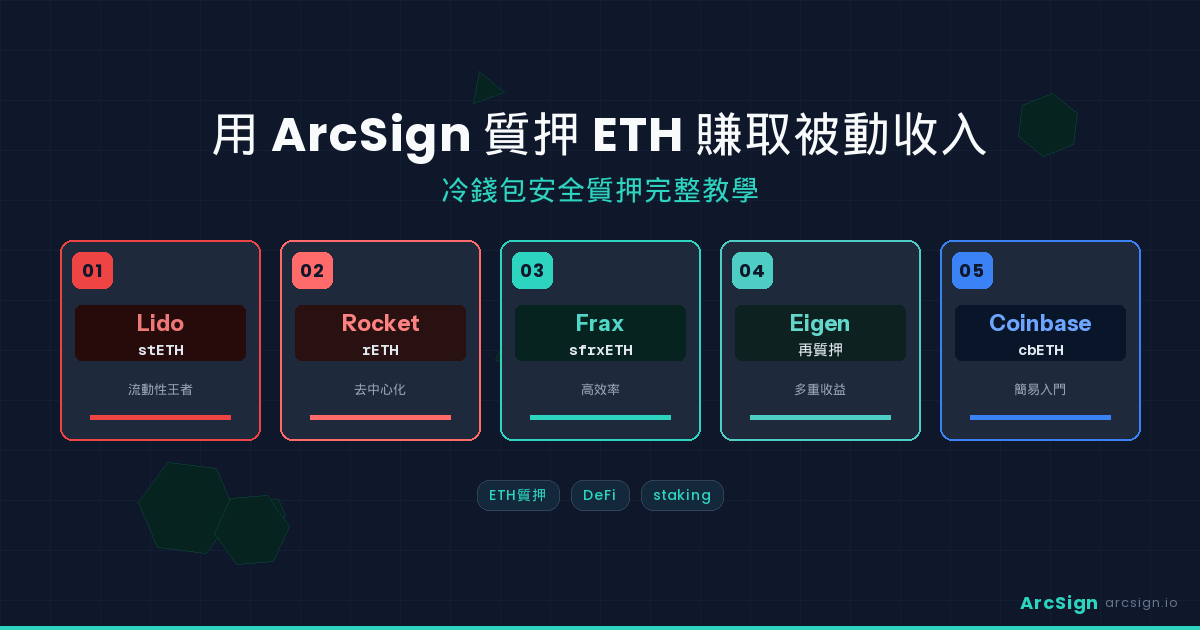
What Is ETH Staking? Why Should You Participate?
Ethereum completed “The Merge” in September 2022, transitioning from Proof of Work to Proof of Stake. This means you can now stake ETH to help secure the network while earning staking rewards. In simple terms, you “deposit” your ETH into the Ethereum validation system, and the network pays you interest in return.
As of 2026, ETH staking annual percentage yield (APY) ranges from approximately 3% to 5%. While this may seem modest, consider that this is passive income built on the world’s second-largest cryptocurrency — with significantly lower risk than most DeFi protocols. More importantly, your principal remains in ETH form. If you were planning to hold ETH long-term anyway, staking is essentially a zero-cost yield enhancement strategy.
Key Data
Over 34 million ETH have been staked on the Ethereum Beacon Chain, representing approximately 28% of the total supply. Staking is not just an individual earning opportunity — it is a core component of Ethereum’s security infrastructure.
Liquid Staking vs Traditional Staking: The Best Choice for Regular Investors
Traditional Ethereum staking requires 32 ETH (over $100,000 at current prices) to run a validator node — far too expensive for most people. Fortunately, liquid staking protocols solve this problem.
How Liquid Staking Works
Using Lido as an example: you deposit any amount of ETH into the Lido smart contract. Lido pools all users’ ETH to run validator nodes. In return, you receive an equivalent amount of stETH (staked ETH) tokens. The value of stETH automatically grows with staking rewards — your stETH balance increases slightly every day, with no action required on your part.
| Comparison | Traditional Staking (Solo) | Liquid Staking (Lido / Rocket Pool) |
|---|---|---|
| Minimum Threshold | 32 ETH (~$100,000+) | No minimum, even 0.01 ETH works |
| Liquidity | Locked, cannot be used | Swap back to ETH anytime on DEXs |
| Technical Requirements | Must run a validator node | One-click staking, zero technical skill needed |
| APY | ~3.5-5% (no intermediary fees) | ~3-4.5% (protocol takes ~10% service fee) |
| Slashing Risk | Self-managed | Managed by professional node operators |
For most users, liquid staking is the most practical option. It lets you enjoy staking rewards while maintaining fund flexibility. And ArcSign’s WalletConnect v2 support allows you to perform liquid staking operations securely from your cold wallet.
Why Stake with a Cold Wallet? Security Advantages
Many people stake ETH directly through browser wallets like MetaMask. While convenient, your private keys remain exposed in an online environment the entire time. Since staking is typically a long-term activity (months or even years), using a cold wallet dramatically reduces your risk.
Three Security Advantages of Cold Wallet Staking
1. Private Keys Never Leave the USB
ArcSign stores private keys in XOR three-shard encrypted form on the USB device. Even if your computer is infected with malware, attackers cannot access your private keys. Staking transactions are signed locally via WalletConnect, and only the signed transaction is sent to the network.
2. Signing Window Only 1-5 Milliseconds
When you confirm a staking transaction, the private key only exists in mlock-protected memory for 1-5 milliseconds. Compared to hot wallets that expose private keys throughout the entire browser session, this exposure window is millions of times smaller.
3. Completely Immune When Offline
After staking is complete, you can unplug the USB and relax. Even if your computer is compromised, attackers won’t find any private key data. Your stETH will safely accumulate rewards on-chain automatically — the USB doesn’t need to stay connected.
Security Philosophy
Staking is a long-term investment — security matters more than convenience. With ArcSign cold wallet staking, you can “set it and forget it” — earn passive income with peace of mind, without worrying about private key security.
Complete Step-by-Step Guide to Staking ETH with ArcSign
Below we walk through the entire staking process using Lido (the largest liquid staking protocol) as an example. The whole process takes about 5 minutes.
Prerequisites
Before starting, make sure you have:
1. ArcSign installed and configured — If not, follow the beginner setup guide.
2. Balances work keyless — Reading on-chain balances needs no API key; ArcSign uses built-in public RPC plus Multicall3. An Alchemy API Key (free tier) is only required if you also want the NFT gallery and transaction history.
3. Sufficient ETH balance — The amount you want to stake plus approximately 0.005 ETH for gas fee.
Step 1: Connect to Lido DApp
1. Open ArcSign and Launch WalletConnect
Click the “WalletConnect” button in the top-right corner of the ArcSign dashboard. ArcSign will generate a connection code. Simultaneously, open stake.lido.fi in your browser, click “Connect Wallet,” select “WalletConnect,” and scan or paste the connection code displayed by ArcSign.
Step 2: Enter Staking Amount
2. Enter the Amount of ETH You Want to Stake on Lido
Once connected, the Lido page will display your ETH balance. Enter the amount you want to stake (we recommend keeping at least 0.01 ETH for future gas fees). The page will show the stETH you’ll receive and the estimated APY.
Step 3: Confirm and Sign
3. Confirm the Transaction and Sign on ArcSign
After clicking Lido’s “Submit” button, ArcSign will display a transaction confirmation window showing the details (recipient address, amount, estimated Gas Fee). After verifying everything is correct, click “Sign.” ArcSign will briefly restore the private key in mlock-protected memory, complete the signature, and immediately zero out the memory — the entire process takes less than 5 milliseconds.
Step 4: Wait for Confirmation
4. Transaction Confirms On-Chain, stETH Arrives
After submission, the transaction typically confirms within 1-3 minutes. Once confirmed, your ArcSign wallet will show the received stETH tokens. From this moment on, your stETH balance will automatically grow daily, reflecting accumulated staking rewards.
You Can Unplug the USB After Staking
Once the staking transaction confirms, you can safely remove the USB. stETH reward accumulation happens automatically on-chain — ArcSign doesn’t need to be running. The next time you plug in your USB and open ArcSign, you’ll see your stETH balance has grown.
Track Your Staking Rewards in ArcSign
ArcSign includes a built-in DeFi position tracker that automatically detects and displays your liquid staking assets. In the dashboard’s “DeFi” tab, you can see:
- stETH holdings — Increases slightly daily with staking rewards.
- Real-time APY — The current annual yield, typically fluctuating between 3-5%.
- Accumulated rewards — Total ETH earned since you started staking.
- USD valuation — Dollar estimate based on real-time ETH price.
ArcSign currently supports tracking positions and yields for stETH (Lido), ankrETH (Ankr), and ankrBNB liquid staking tokens. This data is fetched in real-time through Alchemy and NodeReal APIs for accuracy.
Staking Risks and Management Strategies
While ETH liquid staking is relatively safe, responsible investors should understand the potential risks involved.
Smart Contract Risk
Vulnerabilities in liquid staking protocol smart contracts could lead to fund loss. Lido’s contracts have undergone multiple security audits and are battle-tested with over 10 million ETH, but theoretical risk is never zero. Recommendation: Choose protocols with thorough audits and long operational track records.
De-Pegging Risk
stETH should theoretically maintain a 1:1 peg with ETH, but extreme market conditions can cause discounts (a ~5% discount occurred in June 2022). If you urgently need to swap stETH back to ETH during a discount, you may incur a small loss. Recommendation: Only stake ETH you don’t urgently need, keeping sufficient liquidity in reserve.
Slashing Risk
If validator nodes make serious errors (like double-signing), a portion of staked ETH may be slashed. In liquid staking, this risk is distributed among professional node operators and has minimal impact on individual users. Lido also maintains an insurance fund to cover potential slashing losses.
Token Approval Risk
Staking operations may require approving smart contracts to use your tokens. After staking, we recommend checking and revoking unnecessary approvals in ArcSign’s “token approvals” feature to eliminate unnecessary attack surfaces. ArcSign Pro users can use the batch revoke feature to clean up all expired approvals at once. Learn more in our token approval management guide.
Major Staking Protocol Comparison
Here’s a comparison of the major ETH liquid staking protocols in 2026 to help you choose the best option:
| Protocol | Staking Token | Market Share | APY | Service Fee | Decentralization |
|---|---|---|---|---|---|
| Lido | stETH | ~28% | ~3.5% | 10% | Medium (29 node operators) |
| Rocket Pool | rETH | ~3% | ~3.2% | 14% | High (permissionless nodes) |
| Coinbase | cbETH | ~10% | ~3.0% | 25% | Low (centralized) |
| Frax | sfrxETH | ~2% | ~4.0% | 10% | Medium |
Recommended approach: If you prioritize stability and liquidity, Lido’s stETH is the most mature choice. If decentralization matters more to you, Rocket Pool’s rETH is worth considering. Regardless of which protocol you choose, ArcSign can connect securely via WalletConnect.
ArcSign Built-in DEX Swap
If you want to swap stETH back to ETH, you don’t need to leave ArcSign. The built-in DEX swap feature (integrating OpenOcean + KyberSwap) lets you complete the swap directly within ArcSign, automatically finding the best rate path while enjoying cold-wallet-grade security.
Frequently Asked Questions
Q: Is it safe to stake ETH with a cold wallet?
Very safe. ArcSign connects to staking protocols like Lido via WalletConnect v2, keeping your private keys on the USB device at all times. Keys are only briefly restored for 1-5 milliseconds during transaction signing. Compared to hot wallets that expose private keys continuously, cold wallet staking dramatically reduces theft risk.
Q: Does ArcSign charge fees for ETH staking?
ArcSign itself charges no staking fees — it is free software. You only pay the Ethereum network Gas Fee (transaction fee) and the staking protocol’s service fee (Lido charges about 10% of staking rewards). Gas Fee amounts depend on network congestion at the time.
Q: Can I redeem stETH at any time after staking?
Yes. Lido’s stETH is a liquid staking token — you can swap it back to ETH anytime on DEXs like Curve or Uniswap, or use Lido’s withdrawal feature directly. ArcSign’s built-in DEX Swap feature (OpenOcean + KyberSwap) also supports stETH swaps.
Q: What is the minimum amount of ETH required to stake?
Through liquid staking protocols like Lido, there is no minimum staking threshold — you can participate with as little as 0.01 ETH. This differs from traditional Ethereum validator staking (which requires 32 ETH), making liquid staking accessible to small holders.